Category Archives: Useful Stuff

Productivity Improvements

Category : Useful Stuff

Productivity Improvements, how to achieve massive reductions in set-up times and implement methods that will save you money year on year.

Productivity Improvements
Is all this 5s stuff just a posh person telling us to tidy up

A few years back I worked for a company that supplied pressure control systems to the oil and gas industry.

It all started off with some very expensive Inconel components that were getting scrapped at an alarming rate. It’s a very long story and I won’t bore you with the minutiae.

To cut the story short, the part was on a large WFL Machine Tool and me and a team of engineers studied the production method for several weeks before coming up with the answers.

There was a list a mile long of all the bullshit reasons why these parts were going wrong. The real answers were something totally different.

  1. Machine needed properly re-aligning.
  2. Chucks, steady and tailstock needed full re-furb.
  3. Machine was being crashed on a regular basis.

In fact the machine had been bumped more times than I’ve had hot dinners.

Now I’ve not had that many hot dinners because my mother was always playing bingo and couldn’t be arsed to cook.

Mind you she could sling a mean bag of crisps at you. Oh, and her pot noodles were amazing, so long as we didn’t mind boiling the kettle and adding the water yourself.

We considered this a small price to pay for an otherwise nutritious meal.

The ultimate gourmet meal

Anyway, we asked the operators, in a meeting, how many times the machine was bumped.

“Oh, not many” one said.

“But how many? once a day, once a week, once a month?”

“No, no probably not even every month” was the final answer.

Not happy with this we monitored the machine and kept a log of everything. Turns out the machine was getting minor shunts all day long and bigger bumps at least every week.

We analysed all these “little accidents” and almost eliminated the problem through good training and creating an open honest environment where the operators felt comfortable, honestly reporting any problems or collisions.

Virtually no bumps a bit like these posh women you see with Range Rovers. I mean you see these Range Rovers on TOP GEAR and they can climb up a fuckin mountain upside down at 90mph.

Range Rover

As soon as you meet one of these on a country road guess what? They won’t even move over into a puddle for fear of wetting the fuckin tyres.

These bastards should be banned from the roads a complete waste of space.

Envious Me?

Oh, and don’t think I’m envious. I don’t want to drive around in a luxury vehicle with every creature comfort known to man at my fingertips. With beautiful leather interior. Music softly tinkling from the top-quality, high end, hi fi system.

0 to 60 quicker than a fuckin snow leopard. Room for the family and two dogs. Quietly purring through the rolling countryside.

I should get that front wing repaired

Fuck off I’ll stick with my car thanks very much. It has everything I need. A bit of a tidy up that’s all it needs.

More Ranting

Just one more rant. Near where I live I often have to pass through quite a long country road that’s only really big enough for one car in most places.

How many people can’t fuckin reverse? I mean holy bleedin shit these cars are bristling with technology, cameras, sensors, cruise missiles air conditioned seats. But guess what, the bloke forgot to equip it with a fuckin reverse gear.

They’ll never back up. They sit there looking at you like you just pissed on their sodding Weetabix.

One very dark night, me and this bloke, had to get out of our cars and actually walk behind this car to help the “person” reverse.

If I’d paid 80,000 quid for a car I’d want it to take to the air and fly over oncoming vehicles. This one just didn’t like going backwards.

Anyway, Here’s What We Did

What I’m about to tell you wouldn’t be practical in most companies. You must bear in mind that the cycle time for these parts was around eight hours and the material cost alone would constitute a decent lottery win.

In The Event Of A Collision

  1. We machined a ready programmed standard test piece on the machine.
  2. We fully inspected it with the machine probing system.
  3. It was checked on a CMM (Coordinate Measuring Machine)
  4.  We were really nice to the perpetrator (it’s so nice that you crashed the machine and gave us this opportunity to learn)

If the test piece was OK at the machine probe stage we would allow production to continue. This was a calculated risk but obviously if it went on to fail the next stage we would stop production immediately.

This job had some massive ups and downs but the final outcome was a massive success. It all came down to basic engineering principles. By carefully scrutinising the problem and systematically eliminating each error we got good parts.

Making permanent changes to working practices so that the lessons learnt could be implemented all over the company.


The guys I worked with are still in touch and we earned massive respect for one another.

Qualifications Don’t Matter and It’s Clever to Swear

At the beginning when one of them told me he was a black belt I kept thinking he would beat the shit out of me if I upset him.

Turns out it was a six-sigma black belt and this is quite benign in terms of physical fighting skills.

Six Sigma Black Belt (when angry)

Everyone who knows me knows that my approach is very pragmatic, that means no bullshit to the less articulate.

I would say we need to do this this and this and they would say oh you mean “an overtly incontinent productivity enlightened anal bleaching scheme”

I would agree pretending I knew exactly what they meant.

Unfortunately, I don’t usually have a name for what I want to do.

You know the sort of thing; an untidy workshop I call a fuckin shithole.

They’d say “Dave it needs 5s”.

I said “you’ll need about sixty S’s to clean up this horrendous crap hole”.

“Oh, and please don’t call me Dave, it’s David”

Productivity Improvements

We concluded between us that what they had learnt in college and on courses gaining black belts and all sorts of stuff. I had picked up from working in the real world with real people. Putting the two together made a winning combination.

I still can’t see the point in a black belt unless you get to beat the fuck out of someone but I think maybe I’ve seen too many Bond movies.

CNC Productivity Improvements:

I am sure you have noticed that more time is lost during set-up time than at any other time in your component life-cycle.
Very often a company will ask me to look at the cycle times on components. On close inspection most of their time is lost during the set-up process.

Wall Clock

I may be in a company training programmers or machine training but I will poke my nose into everything and maybe suggest that we take a look at CNC Productivity Improvements.

Small Batch High Quality Parts

Manufacturing in the UK is tending to move towards lower batch quantity due to lower production costs aboard. We are moving more and more towards low volume high quality parts. This means CNC Productivity Improvements are desperately needed because a much larger percentage of manufacturing time is concentrated on set-up times.

Productivity Improvements

If you are only making six parts you can almost guarantee that the CNC set up time will be where all the time is used up. If you can’t guarantee repeat business then I am afraid it gets worse.
Unfortunately we rarely have the situation as it was in the past. We could spend months refining production methods to recoup it all when the job went into production for five years CNC set up time is then amortised.


The problem is when we are setting our CNC Machine we tend to lose control. Predicted CNC set-up times are not met or even worse we didn’t know what they were in the first place.

Productivity Improvements, Do this now:

  • Keep good records of every job you ever do.
  • Knowledge is power but with history we can improve and build.

You may have already machined a very similar part so this will make quoting easy.

Filling Cabinet

Rules For Life

The methods we employ at The CNC Training Centre are rules for life. Take a look at this video on how to set a vice without clocking it. This is a classic example of something that, once it is implemented, is the gift that keeps on giving and that’s what we want.

Productivity Improvements

The way you set a CNC component is crucial.

Does the following Sound Familiar:

Great we set a job on our CNC Machine really fast and in no time, we get a part into inspection.

Just need a pass off and away we go.

Inspector “everything is ok just a few minor adjustments”
A week later we are still adjusting.

Confused

So, what went wrong?

My guess would be:

  • Job not carefully planned.
  •  CNC Prove-out method is wrong.
  •  Incorrect and inaccurate CNC tool setting.
  •  Not using a systematic approach.
  •  Poor feedback from quality department who might not understand exactly how the job was machined.
  •  The CNC set-up needs to be systematic and accurate.
  •  Each step of the way should be correct and complete before the next stage is undertaken.

This can be taught and it can be written into an SOP (Standard Operating Procedure) which can be used again and again.
It sounds perverse but I would be suspicious of anyone who sets a job on a CNC Machine too quickly.


Productivity Improvements, No Blame

My pet hate (and you have loads when you get to my age) is when supervisors blame setter operators for long set-up times. “You’re the boss mate what are you doing about it?”

Telling off
If you ask someone, and I frequently do, why it took so long to set a job. They can never tell you. But if you look carefully you will find that most of the wasted time is looking for things.

Also it’s not actually his fault so you just fired him when you should have resigned yourself.


I want to bolt down my vice.

Question: Where is the vice?
Answer: Under the bench somewhere. (5 minutes)

Question: Is it clean?
Answer: No fuckin way I even had to stone some dents out of the bottom. (10 minutes)

Question:  Where are all the rags?
Answer: Dunno mate go and get some more form the stores. (6 minutes)

Question: We got any tee nuts?
Answer: Go and ask Tom (15 minutes), oh and he told me about his cats hernia operation and gender transformation.

Question: These tee nuts don’t fit, do you know what size they are?
Answer: Go and ask Tom (10 minutes)

Question: Is this vice far enough over on the table?
Answer: No the machine just over travelled you’ll have to start again. (10 minutes)

This took nearly an hour. Then the boss comes down and really pisses you off cos he wants to know when the job will be off the machine.
I am doing my absolute best but everything is going wrong. The thing is this is all the bosses fault. Now I have an attitude problem to boot.


What you should do:

  1.  Plan the job meticulously and get everyone involved.
  2.  Do a proper contract review to check you have everything, and I will repeat, everything that you need. (Real attention to detail is needed here.)
  3.  If you have CAD CAM check everything in the virtual world. Carefull check CNC Code for obvious errors. Mistakes found at this stage cost little nothing to put right.
  4. Now if you are the one running this show. Make sure everything is at the side of the machine before your customer starts work. Your customer being the guy who actually makes something (the machinist).
  5. Check condition of everything, look for damage or anything that slows things down.
  6.  Don’t leave anything to chance, think that you do not want him to leave the duck board unless he needs food, drink or a piss. Make him a cup of tea if he wants one and don’t forget the biscuits.
  7.  Work area. You already know this stuff. Everything should be in a clearly marked place. Only what is needed, no more. Definitely not a full set of Allen keys just the ones you need and I bet it’s a maximum of four.
  8. As a supervisor or manager you are an overhead, a non producer. If you take the dents out of the vice the machine doesn’t stop. When the setter operator does this the machine probably will be stopped.
  9. Try and get the machine operator involved in the preparation but make sure his machine never stops.

“King Rollo’s Playroom”

Maybe you need to check out the story of “King Rollo’s Playroom” before he made some CNC Productivity Improvements.

I will summarise it for those who were deprived of this story as children. In a nut shell he refuses to tidy his play room but then finds that he is tripping over his toys and breaking them and he can’t find anything either.

Not to spoil the story but King Rollo gets really fucked off about breaking his toys and does the right thing and tidies up.
Sound familiar this could be you folks.

CNC Productivity Improvements

Everyone Wants To Work in a Clean Workshop

If you came to my front door in muddy boots and I open the door and you see a pristine immaculate house carpeted in white. What do you do?

You remove your shoes.

But if I opened the door and the house was filthy with straw on the floor you would probably want to wipe your feet on the way out.
The point of this is that if you’re environment is immaculate, anyone coming into it will feel obliged to conform and if they don’t they will stick out like your dirty boot mark on my white carpet.

 Productivity Improvements


Productivity Improvements Investment

Companies very often invest hundreds of thousands in machine tools but refuse to buy more than one 19mm spanner when the operators keep losing them. Daft, you might say, but I bet you are already thinking of similar things in your own company.

The beauty of an outsider doing all this for you (and I would say that) is that they can do all the things you wanted to do but never seem to have the time.

Typically, this is how The CNC Training Centre would help you with CNC Productivity Improvements.

  •  Spend some time (a few days) observing what you do.
  •  This may involve videos and loads of listening to the machinists at the “coal face”.
  •  Meet with managers, supervisors and setter operators and discuss findings. Then you will tell me what we are going to do.
  •  Yes, that’s right you pay me so that you can tell me how you would improve things.
  •  It is true most of the ideas will come from you and the guys on the machine will say “I have been trying to get them to do that for years”
  •  A report is prepared outlining a plan to move forward.
  • Identify training needs and relevant CNC training courses and CNC programming courses if needed.
  • Implement CNC machining process improvement

Then we do it.

Most of this study involves little or no loss to production. The cost of implementing the productivity improvements is usually very low as most of the savings are in very practical low-cost areas.

Productivity Improvement Costs may include:

  • CNC training courses and CNC programming courses.
  • Applications Engineering time to implement CNC Productivity Improvements.
  • Purchasing of inexpensive items such as spanners, clamps, Allen keys etc.

You can expect to see massive reductions in set-up times but above all these times are consistent and predictable. This allows accurate future job costing.

Productivity Improvements

Please note no Range Rover drivers were injured or maimed in the production of this article.

I hope this article inspires you to improve things and get more productive.


Jumping Sections of Programme Using M99 and Block Skip


Click for M99

Please contact me if you require:

  • CNC programming training.
  • Want to learn CNC programming.
  • Fanuc control training.
  • Yasnac programming training.
  • Any type of CNC course.
  • Fanuc training courses
  • CNC lathe training
  • CNC Vertical Machining Centre training

Contact: 07834 858 407

Services offered at CNC Training Centre

Edgecam training.

Classroom programmer training.

Onsite CNC Machine Training.

CNC Training on all controls and machines.

Mazak Training Fanuc Training

Don’t forget we offer training on all types of Mazak Machines and all Fanuc Controls 6m to 31i Oi old to young.


CNC Applications Engineer

Category : Useful Stuff

CNC Applications Engineer

When I was younger the job I really aspired to  was a CNC Applications Engineer.

Actually it’s not really true because being a part time rock singer I obviously wanted success from that but let me describe that as more of a dream. Oh and I don’t think you can describe being permanently pissed, incredibly wealthy and shagging all day as a job.

Anyway I will not digress.

I didn’t actually have a CNC application engineer job description but whenever I got to work with these guys I was in awe of them.

(I just realised I didn’t know the difference between ore and awe)

I remember being trained by a guy from Hitachi Seiki

They were a top class company with some amazing machines that are still around today.

They were taken over  by Mori Seiki in 2002 after going into bankruptcy.

Company Car Wow

The guy training me was Clive and he was and still is a very talented engineer. We got on great and I still talk to him sometimes to this day.

I thought how great it must be to travel all over the country staying in nice hotels. Oh and he had a company car.

Ford Sierra Estate car from the 1980's
Thanks to Simon Classic Car Auctions


I could have sworn Clive had a Sierra but in fact I just messaged him and he said it was a red Ford Escort. Just like this, I don’t know if he had his name across the top of the windscreen.

Red Ford Escort
Red Ford Escort

Now you might be thinking that I must have been easily impressed but these cars really were the dog’s bollocks in those days.

Dog’s bollocks what does he mean?

The job we were doing was a turned part for a fork lift truck and we had one of the very early robot loading arms.

This was around 1985 so they’ve been around longer than you think.

CNC application engineer job description


I remember he had a really methodical and systematic way of doing things and the final part was perfect.

By the way if you ever work with robots you need to be really precise in the way you do things.

His approach has stuck with me to this day and I still try to work that way. I mean it’s easier when you are old like me to not rush. But this is not bullshit because I can’t sprint round the block like I used to.

It’s a bit like driving fast I drive slow because, although it took several years to realise this, no one tends to die.

It’s not because I can’t drive fast.

I mean if I had one of these I might be tempted

CNC Applications Engineer

What do they actually do?

Here is a kind of CNC application engineer job description

Shit loads

So it’s any or all of what is listed below.

  • Commission Machine.
  • Write CNC code long hand.
  • Design and manufacture fixtures and tooling.
  • Setup machine.
  • Prove-out programs.
  • Check the parts and get final approval from quality department.
  • Train the operators.
  • Train programmers.
  • Make tea.
  • Program using a CAD/CAM system.

Interested?

A lot of what a CNC applications engineer does could be described as Production Engineering.

I did have to google Production Engineering to see if I had it right. It seems I might not have but to be honest who gives a flying fuck.

Production Engineering to me is controlling or doing the whole process of getting a new part produced. From design of work holding right through to final inspection.

That’s why being a CNC Applications Engineer was always so appealing to me because it’s never boring.

So How do You Get There?

Well the answer is it takes time, years in fact.

Oh and did I mention you have to be good.

Now this article is not meant to be a plug, but we do offer courses to help you keep moving up to the next level in your engineering career.

“Come on Dave you lying bastard what are all these links to courses for if you’re not plugging?” you may say.

I’m not answering that because I keep telling you not to call me Dave, it’s David.

CNC Operator (Step 1)

(One up from making the tea)

  • Pressing the button.

Production Engineering

  • Cleaning the parts.
  • Removing sharpe edges from the parts.
  • Checking the parts.

You could end up doing a lot more than just pushing buttons. Rather depends on the company you work for and your attitude.

Show your interest and gently push to do and learn more.

CNC Machine Setter Operator (Step 2)

  • Setting tools.
  • Setting datums.
  • Prove out programs.
  • Altering wear offsets.
  • Changing worn or broken tools.
  • Maybe minor program alterations.

Try to learn as much programming as you can in this role. Watch the machine and the program and try and link the two together.

Programmer Setter Operator (Step 3)

Write your own program on the machine as well as all of the above.

Don’t forget the real engineering is knowing how the tools perform and really understanding the work holding.

Programmer (Step 4)

Programming on or off the machine progressing to learning a CAD/CAM system like Edgecam

This is where you get to create potential havoc and break loads of tools.

CNC application engineer job description

Production Engineering (Step 5)

  • All of the above
  • Finding suitable tools and buying where necessary
  • Designing and managing work holding

In this role it’s difficult to know exactly what your company will ask of you. It varies massively from one company to another.

CNC Applications Engineer (Step 6)

Come on concentrate I already told you this earlier in the article. Go and watch some fast cars on YouTube you obviously are not concentrating.

Normally as a CNC applications Engineer you would d be working for one of the big machine tool companies or one of their dealers.

I think if I had my time again I would have tried to work for them all. I have worked independently now for much longer than I would care to mention.

OK I’ll care to mention, nearly 30 years.

You Might Not Settle

Even if it’s not the job that you think you’d like to stay in forever it would be a massive stepping stone for other things.

Every step of the way:

  • Be confident.
  • Tell the truth about your achievements.
  • Learn as much as you can.
  • Ask loads of questions.
  • Treat everyone with loads of respect even when they don’t deserve it.
  • Never ever bullshit your way into a job, it usually ends in tears (probably yours)
Never bullshit your way into a job.

CNC Turning Using T00 to Cancel Offset

CNC Turning Using T0000 to Cancel Offset

This article is about CNC turning programs and the use of T00 or T0000 to cancel the tool offset.

My daughter is autistic, and one of the things that she has taken great delight in doing during the Covid lock down, was picking up on the stupid nonsensical phrases and expressions that neurotypicals have created in their non-binary brains.

In case you don’t already know neurotypical is an expression used by autistic people to describe non-autistic people. I still haven’t worked out if it is a term of endearment or mildly offensive but I don’t really care anyway.

Anyway, whilst I was writing an article about using multiple offsets, yet to be completed, I suddenly realised why it is a good idea to cancel the tool offset on a CNC Lathe (more about that later).

We were sat drinking tea in our summer house, me my wife and my daughter.

I know it sounds grand but really, it’s not exactly a summer-house it’s more of an old shed. It’s one I converted to compete with my neighbours when they had a fancy new summer house built.

Just a few finishing touches needed

I was talking about this article in rather abstract terms as my wife and daughter are none engineers but always pretend to be interested in my rantings.

Anyway, with reference to tool offset cancellation I said “you learn something new every day”.
My daughter immediately retorted “oh so what did you learn yesterday?”. Fortunately, I could think of something I remembered learning that there are 206 bones in the human body, so I used it.


I need to add a this point that my daughter is not an autistic savant and we still need google and takeaway menus. She’s not like that bloke in “Rain Man” who can remember every number in a fuckin’ phonebook.

The expression is “if you know one autistic person, you know one autistic person”

Anyway with her autistic brain I should have known this wouldn’t suffice. “The world tilts at 23.5 degrees on its axis” I quickly added.

“You already knew that” she said.

(Please ignore this if you think the world is flat as I know a lot of my readers do)

She insisted that I should go back at least three weeks in order to prove the validity of the statement.
I decided to give in and the conversation ended by me admitting that all neurotypical people are stupid.

In our household that’s a result and a common strategy we use to resolve this kind of conflict.
Such idioms as “washing your dirty laundry in public” are just banned unless you think you have a simple way of explaining it.

A friend once exclaimed that “there is more than one way to skin a cat!” and as a result required a police escort to get home (joke).

My daughter has a cat and her whole existence revolves around it. I’ll let you imagine her reaction.

Using T00 to Cancel tool Offsets

Anyway, this was going to be an article about using multiple offsets in a CNC Turning program.

They are a bit like multiple orgasms but not nearly as much fun. Anyway I had this eureka moment with regards to T00 and ditched the whole thing.

On a CNC Lathe we use a four-digit number when we do a tool change.

T0101 for example.

The first two digits make the turret index T0101 (index to tool 1)

The second two T0101 will call an offset. You will note I said an offset because it can be any.

By the way some controls like Haas omit the first zero on a tool change.

CNC Turning
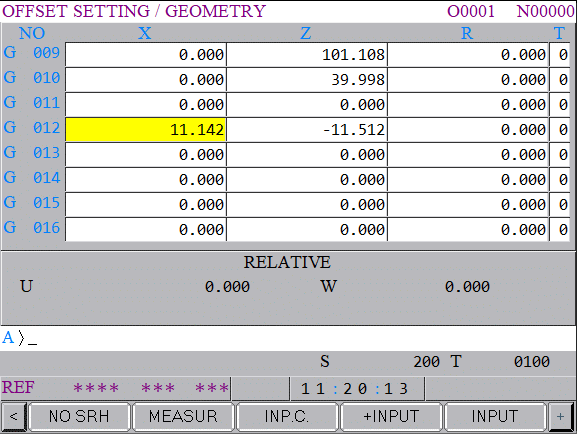
Geometry offset page on a Fanuc CNC Lathe

In the above case it’s offset 1 but it could be T0112 this would index to tool 1 and use offset 12.

CNC Turning
Geometry offset page on a Fanuc CNC Lathe

Anyway thinking about these four digit numbers made me think about when you use zeros.

On older machines you used to have to cancel the offset by stating T0100 or much safer T0000. Otherwise the machine would add the new offset to the old one and a shitstorm would ensue.

I had consigned, this now inert procedure, to the CNC Turning equivalent of room 101 or at least the annals of CNC History. Anyhow, it seems there is life in the old T000 dog yet.

I love this puppy I’m going to use it in every post from now on

Now this is where that eureka moment happened in my summer house / luxury shed and I wrongly claimed to learn something new every day.

The Theory

When you write a CNC Turning program you can either return the tool back to the machine reference or return it to a tool change position.

Now the first option (reference) is OK if it is a small a machine. In other words it’s not gonna take it a week to get there.

On a big machine you would have to navigate around all sorts of shit like the tailstock or a steady or the boss’s Bentley. And it would almost definitely be a waste of time.

Soooo normally we would use a tool change position. This would be making use of G53

CNC Turning

Using G53 for tool change position

CNC Turning G53

Because the G53 uses the machine coordinate system it will be the same place for each tool.

CNC Turning

You could then put this position in a sub program. That way it would be the same for every tool. If you needed to change the position you would only need to change it once in the sub-program.

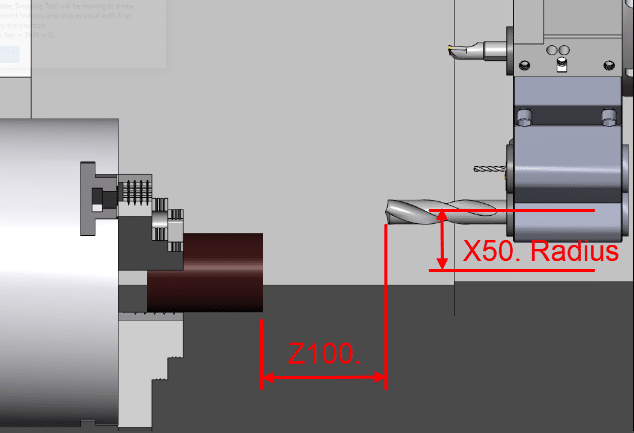
I will forgive beginners for thinking you could just rapid each tool to the same position away from the work piece.

For example G0 X100. Z100. for every tool.

CNC Turning
Sending a drill to a position
CNC Turning
Sending a turning tool to a position

Just look at the turret position in the pictures above. Although the X Z position of both tools is the same there is a huge difference in the turret position.

This could work but when you pick the program up again maybe months later. The tools could be different lengths the tool-change position would have to be altered.

Your drills may not be the same length and the machine may even over-travel when you try to move it to your old tool change position..

Using a G53 you can always allow for the longest tool and know your index position is safe.

Remember G53 does not consider the tool offset or the work offset. To be honest G53 is the selfish bastard of the G codes it just does not give a flying shit what offset is active.

Eureka

Anyway, thinking about cancelling tool offsets it gave me an idea.

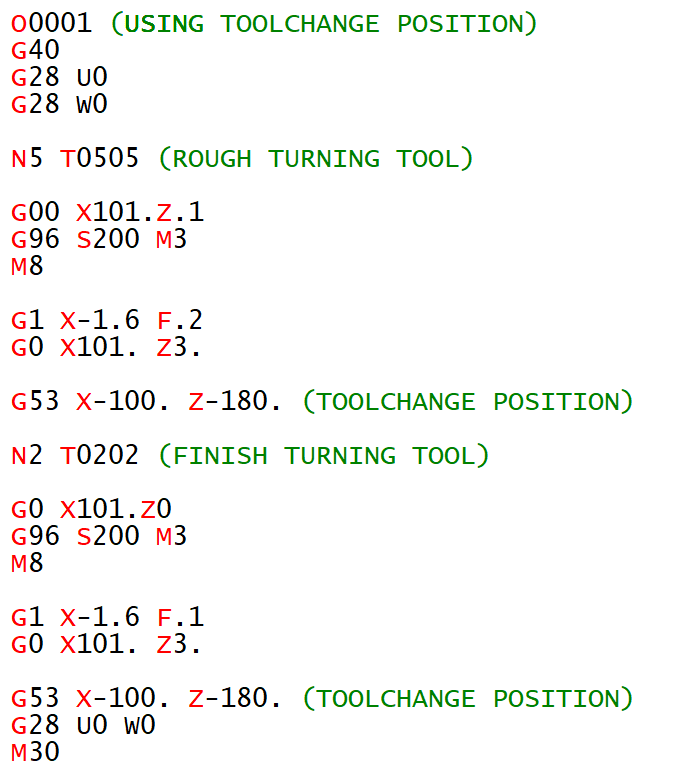
If at the end of each CNC Turning tool you cancel its offset. you could send it to a known position.

Because no tool offset is active this would always be the same place.

Some of you probably already do this but honestly, I never thought of it.

I intend to program this way from now on.

CNC Turning
Using T00 for your tool change position

You should be able to use T00 or T000 to cancel your tool offset.

Don’t Do This (I really shouldn’t be telling you)

You can use the tool number plus the zeros so to cancel T0101 you could put T0100. I strongly recommend that you do not do this because it introduces an index move and therefore another potential collision.

You would need to remember to change this on all tools if for some reason you moved the tools around in the turret.

Oh yea about the multiple offsets. I will be writing and article on it when I can be arsed but in the meantime here is a video.

Thanks for reading my articles (no flies were killed in the writing of this article) except for the little bastard that’s flying around my office.

I will ask it politely to leave or else.


Adding a Fourth Axis or Indexer to your CNC

Category : Useful Stuff

Fourth Axis or Indexer?

When we talk about a fourth axis it means that we have four simultaneous axis X Y Z plus one other.

That means you can move them all together (the moves are simultaneous) and they are all timed together.

It’s a bit like trying to pick your nose and scratch your arse at the same time. You can get mixed up and poke your eye out.

CNC Machines are much better at this kind of stuff than we are.

Below is what happens when you program an X Y Z and C (rotary axis) move in one block of code.Fourth Axis

The one below is on a lathe so the Z works  the same as the X above.

In this program it’s just a Z C move or on a CNC Milling Machine it would be X C

Fourth Axis

Simultaneous

In the above example just the two axis (Z and rotary) are simultaneous..

If your machine has a simultaneous fourth axis, sometimes known as a full fourth axis.

On the position display you will see X Y Z but you will also see C (sometimes A or B I’ll explain later)

A full A B or C axis will be programmable in .001 degrees. That’s one thousandth of a degree (very small).

Typically G0 C185.326 rotate to 185.326 degrees

If a machine has an indexer and not a full fourth axis it normally won’t be shown on the position display.

Another thing to note about a full fourth axis is that it doesn’t stop at 360 degrees and start again at zero.

Angle wise 0 and 360 are the same but if you are talking simultaneous then it’s continuous.

Are you confused?

This is my pet goat his name is Beelzebub I named him after a famous politician.

Let me explain. In the example above (the fourth axis example, not my goat) you want the fourth axis to rotate more than once.

You programme C1440. which is 360 x 4 and it turns four times and the other axis works simultaneously.

So if the other axis (X) is moving 60mm. For each turn it moves 15mm. Just like a 15mm pitch thread.

Ok you get it now? Good. Very good. Just when I am starting to loose my fuckin patience with you.

The number of times I have to beat my students with sticks these days is getting more n more.

So What’s an Indexer

When we talk about an indexer on a CNC machine this means we have a rotating axis but we can only move it to a position. This can be 1 degree or .1 degree depending on the machine tool.

Whilst these are really useful you can’t do all that clever shit that you see above. So don’t get confused especially if you are footing the bill for a new or second hand machine.

Check the minimum angle you can index. If you have a part and it has holes at 10.5 degrees and your indexer is one degree increments then you’re knackered (or fucked but I have decided not to swear in these articles anymore).

You could be disappointed. “Sold a pup” as my mother used to say. I”l have to ask her what the fuck that means.

Don’t you just love them. I know they’re little portable shit machines but soo cute. Make lovely Christmas gifts.

Not on Linkedin though for fuck sake. Anyway enough gratuitous crap.

Retro Fourth Axis

Retro, a bit like sick and gay, this word has a totally different meaning to an old guy like me.

Political correctness to me means voting for the correct political party.

Now with regards to an indexer retro means it’s added on, like sticking a spoiler on your old Mini Metro.

What retro doesn’t mean, is wearing your dad’s old Parker Jacket and thinking you look cool when you actually look like a prick.

Anyway when you add an indexer to an existing machine you control it by a dedicated M code from the CNC Machine.

Your indexer will have it’s own little control system and programme. This programme will be a series of index moves probably followed by clamp and unclamp command.

The machine will send an M code to the indexer and won’t continue until it gets a signal back from your indexer saying it has completed whatever it is doing.

Now your CNC machine doesn’t give a flying shit what the indexer is doing, but it won’t carry on until it gets the signal back saying it’s complete. It’s like wall papering the hall through the letterbox, unless of course you are a gynaecologist.

You do have to be careful with all this stuff but it’s a relatively cheap way to get a programmable indexer.

Haas Fourth Axis

Haas machines come really well equipped and it’s usually relatively cheap to add a full forth axis years after you bought the machine.

After all they used make the bloody things, before they made CNC machines, I think.

They do a great range of add on bits n pieces.

Extras

This is all stuff to consider when you buy a CNC machine new. It can be really expensive to add at a later date as an extra. So bite the bullet, grasp the nettle and get one with your new machine. Give them my name so I get a fat commission.


Simple As ABC

A rotary axis can be called A B or C. This will depend on which axis it runs through.

On a vertical machining centre like this one the centre of the fourth axis runs along the X axis so it’s called an A axis

Fourth Axis

If it runs through Y it’s called a B axis. And Z well……. try n guess.

Full Fourth Axis Useful or Just Bullshit

In the real world there aren’t actually loads of jobs that need a full simultaneous fourth axis. Radial slots maybe radial engraving.

When you start talking about indexing to angles and just doing stuff, well there are loads and loads of uses. For example with a square part you can get all around it just by indexing so your part can come off complete.

Leave Your Fourth Axis Setup

Don’t forget to set your fourth axis as far to the right as you can so you don’t have to keep taking it off.

You should consider a base plate That way you can mount your indexer outside the machine stroke.

By mounting your indexer I don’t mean trying to shag it by the way.

Taking a fourth axis  off and on can be a real pain the arse.

Also don’t forget to use a G10 to store the work offset. If you don’t know how to use G10 then be ashamed of yourself and read this.

Add an Indexer or Fourth Axis

Adding an indexer or fourth axis to your small CNC Machine will increase capacity and allow you to rotate parts to get to areas you didn’t even know were there.

Here’s a free advert for someone

Surface AreaFourth Axis

If you consider the long cube on the axis above. You actually have four faces so it can be a lot of surface area when you add it up.

A lot of people make these cubes themselves and it can save money like baking your own cakes or performing your own keyhole surgery.

Thanks

Congratulations you are the first person to get to the end of one of my articles without being bored shitless.

If you feel you have been affected by any of the issues raised in this post or need CNC Counselling then contact me.

If you want to learn to programme CNC Milling Machines

Siemens 840D Sinumerik training

Look no further Contact CNC Training Centre


Careers in CNC

View all current vacancies in CNC

Click here

Call David: 07834 858 407