Category Archives: Useful Stuff

Onsite Doosan CNC Training UK – Hands-On Courses

Onsite Doosan CNC Training UK – Expert Hands-On Courses at Your Facility

In the competitive UK manufacturing sector, your Doosan CNC machines are key assets for delivering precision turning, milling, and multi-axis work. But to get the absolute best performance from models like the Puma series lathes, Lynx compact turning centres, or DNM vertical machining centres, your operators and programmers need targeted, practical skills.

Call David: 07834 858 407
CNC Training Centre Reviews

That’s where CNC Training Centre excels: we provide onsite Doosan CNC training right on your shop floor – no travel, no lost production time, just real results tailored to your exact machines and workflows.

Why Onsite Doosan CNC Training Delivers Superior Value

Doosan machines (now known as DN Solutions) have earned a stellar reputation in the UK for their durability, high-speed capabilities, FANUC controls, and versatility across industries like aerospace, automotive, medical devices, and precision engineering.

Yet the biggest untapped gains often lie in operator expertise.

  • Zero production disruption – Training happens where your team already works, using your specific Doosan lathes, mills, or multi-tasking centres.
  • Hands-on with your reality – Practice on your actual fixtures, tooling, programs, and materials – far more effective than offsite or generic simulators.
  • Fully customised sessions – From foundational operator safety and setup to advanced Doosan programming training onsite, live tooling, Y-axis, sub-spindle ops, probing, and cycle time reductions.
  • Quick, measurable ROI – Teams apply new skills immediately, slashing scrap rates, shortening setups, minimising errors, and increasing output.
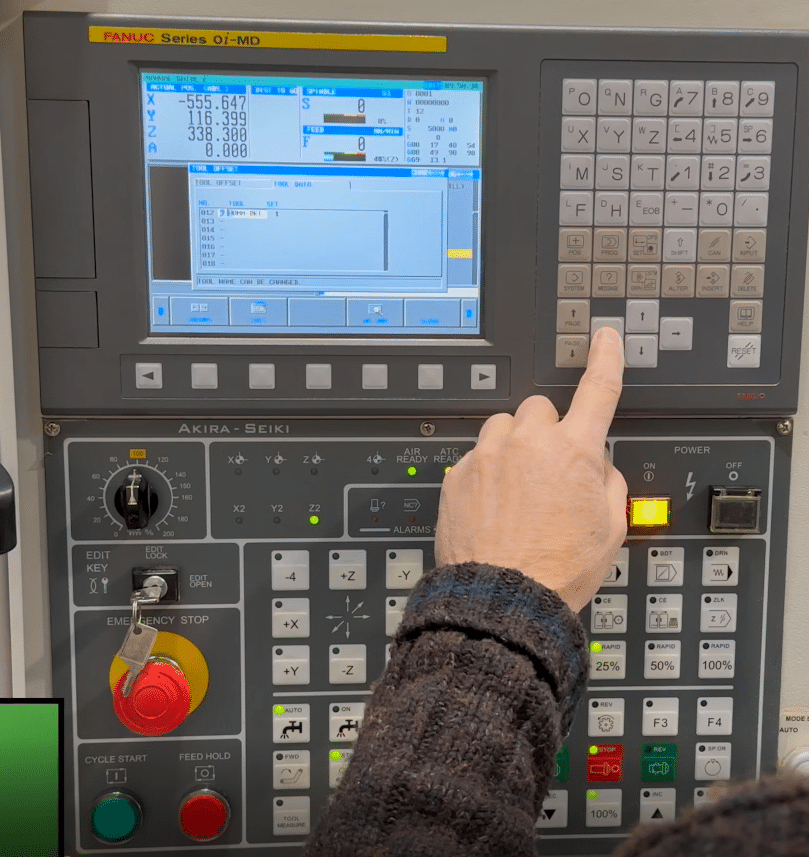
Onsite Doosan CNC Training


Investing in premium Doosan machine training onsite empowers your workforce to fully exploit the reliability and innovation built into every Puma, Lynx, or DNM model – helping you stay ahead in a skills-short UK market.

What Our Onsite Doosan CNC Training Includes

Every course is built around your Doosan lineup and production goals. Core topics typically cover:

  • Safe operation, daily checks, and preventive maintenance
  • Rapid, accurate setup and workholding strategies
  • G-code mastery plus conversational and Manual Guide i programming techniques
  • Toolpath optimisation for turning and milling efficiency
  • Advanced capabilities: live tooling integration, multi-axis machining, in-cycle probing
  • Common troubleshooting on Puma CNC training onsite, Lynx Doosan training, DNM machining centre training, and similar models

Delivered by seasoned instructor with extensive Doosan experience, our sessions provide industry-proven insights you can trust.
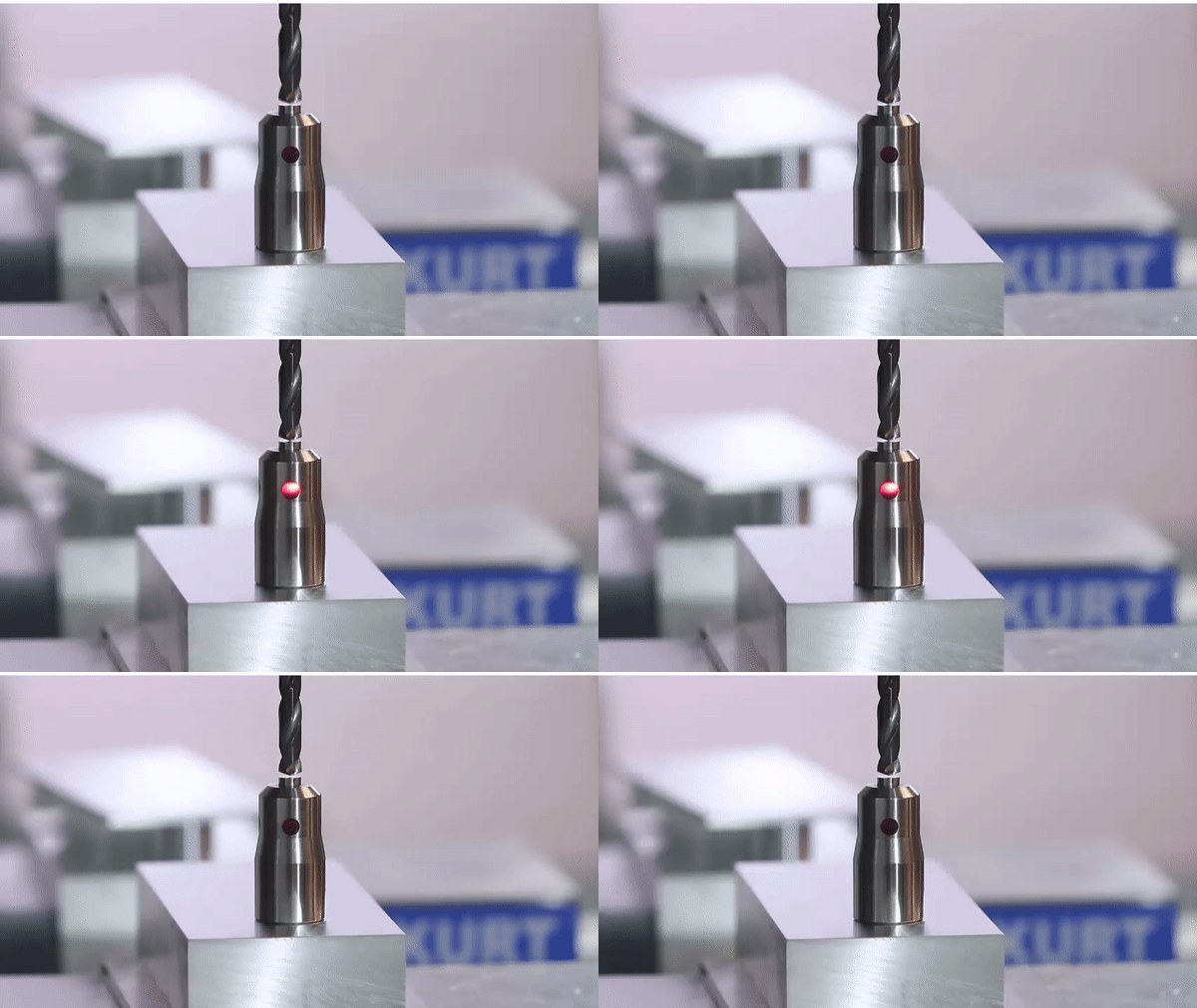
Onsite Doosan CNC Training

Ready to Maximise Your Doosan Investment?

Don’t let under-skilled operators hold back your high-performance Doosan CNC machines. With Doosan CNC training from CNC Training Centre, you’ll see faster setups, better part quality, reduced downtime, and a more capable team – all without anyone leaving your premises.

Call David: 07834 858 407

CNC Training Centre Reviews

Your Doosan machines are built for greatness. Let’s ensure your team is too.

Expert onsite Doosan CNC training – practical, effective, delivered where it matters most.
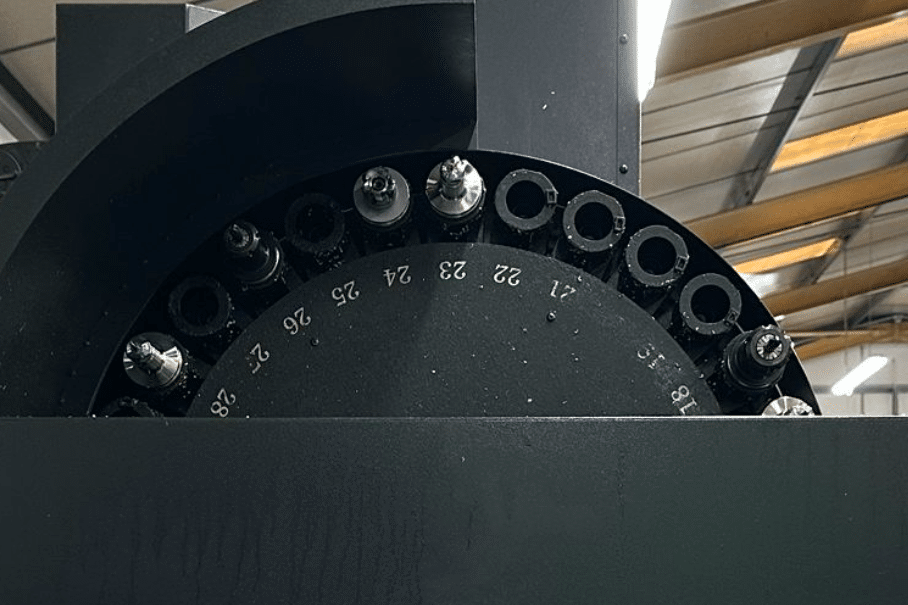

Avoid CNC Crashes Don’t Reinvent the Wheel

This is an article designed to help you avoid CNC crashes.

Call David: 07834 858 407

CNC Training Centre Reviews

I listened to a fantastic documentary on Radio 4 the other day about Airline Crashes. The program explained how the hierarchy (cabin crew, flight crew) caused wrong decisions to be made.

In the Kegworth air Crash, cabin crew knew that the pilot had shut down the wrong engine. Unbelievably no one felt empowered to tell the pilot. The program went on to explain about “The No Blame Culture” and how they had taken this further and created a system where everyone could speak out.

Although this is not the main crux of my post it does highlight some of the points I want to make.

So when a machine crashes. What do you do?

  1. Whose fault is it?
  2. How easy will it be to fire this person?
  3. How quick can we get the machine running again and make some parts?


WRONG!!!!


Avoid CNC Crashes


The above are all the things I definitely would not do.

LinkedIn is full of all these soundbites and bulshit.

Quick one word banners. You know the stuff.

Avoid CNC Crashes“Don’t Eat Yellow Snow”. Well maybe that’s not one on LinkedIn but you know the sort of stuff I mean.


Anyway I bet there is one about making disasters into learning opportunities.

If you know one then send it to me. Cos I agree.

So when you have a collision on a CNC Machine here is what you do.


  1. Make it very easy for everyone to tell you exactly what has happened.

  2. Do not apportion blame. It must be seen as a way to improve things (a learning opportunity).

  3. Make a detailed report on the whole incident.

  4. Analyse the report with all parties involved.


When you analyze the information you have gathered, try to break it down into small parts.

(Oh and by the way if you think this is a waste of time work out what the collision just cost you.)

Each time you spot something wrong come up with a permanent solution so that it can never happen again.

The idea is that you only make the mistake once. If you say things like “he’s an idiot”. What are you going to do about that? Well maybe you could sack him. That is after he punched you for calling him a twat.

Sorry but this won’t work. Next time you inadvertently employ an idiot your machine will get broken again.

Avoid CNC Crashes

Now the idea is to Avoid CNC Crashes. If an idiot can operate the machine and not crash it then we have a solution.

I once suggested in a meeting that we fire all the machine operators. The management team had gone on at length about all the problems with staff and how useless they were.

man-110307

What would we do then? I was asked. Well we will recruit more. What would we get?

  • A moaner.
  • Someone who is  often late.
  • A person who has loads of sick days.
  • The guy who crashes machines.
  • A brilliant worker.
  • A total prick.
  • One not so brilliant worker.

Actually you would get what you have now. So the message is to work with the staff you have and get the best out of them.

So an example would be:

An operator altered a program and made a mistake. This resulted in the machine crashing.

We could carefully analyze what happened and come up with solutions. These would then become part of everyday procedures,

  1. You could remove the edit key so that operators needed supervision to alter programs.
  2. You could make a tutorial video on the prove-out procedure after program alteration. Then get all involved to view it.
  3.  What did he alter wrong? Maybe there is a training issue.
  4. Maybe he missed out a decimal point and needs to read my post.


Some ideas below on how to help Avoid CNC Crashes.


Wrong Offset

Always prove out correctly remember the movement after the tool change is very often the most dangerous one as this is when the offset is applied.

Always adjust the wear offset not the big number (Geometry)

Always use + INPUT that way you any mistakes will be smaller. Depending on settings Fanuc will show you the result before you input i

Avoid CNC Crashes


You can also restrict the value it can be adjusted by read this.

This control has a WEAR screen and a GEOM, geometry screen.

What changed?

If program has been used many times before. There should be a procedure in place to keep it in a special folder marked “proven”.

  1. You may be using different tools so did you edit the tool numbers?
  2. Do  the offsets correspond to the tool numbers H and T? oh and don’t forget the D read this.

The Rules

If this is an existing program then the first tool moving toward the part is the most dangerous move.

  • Your work offset could be wrong (G54 to G59) or work shift on a CNC Lathe.
  • Tool measurement could be wrong.

Once this first tool is proven correct then you know your work offset and your first tool are correct. Beware if the work offset changes say from G54 to G55.

G54 may be fine but what about G55?

From now on you need to check the line  where each tool comes into the component.

Once the tool is in use it’s happy days. Just keep an eye out for changes in work offset (G54 to G59).

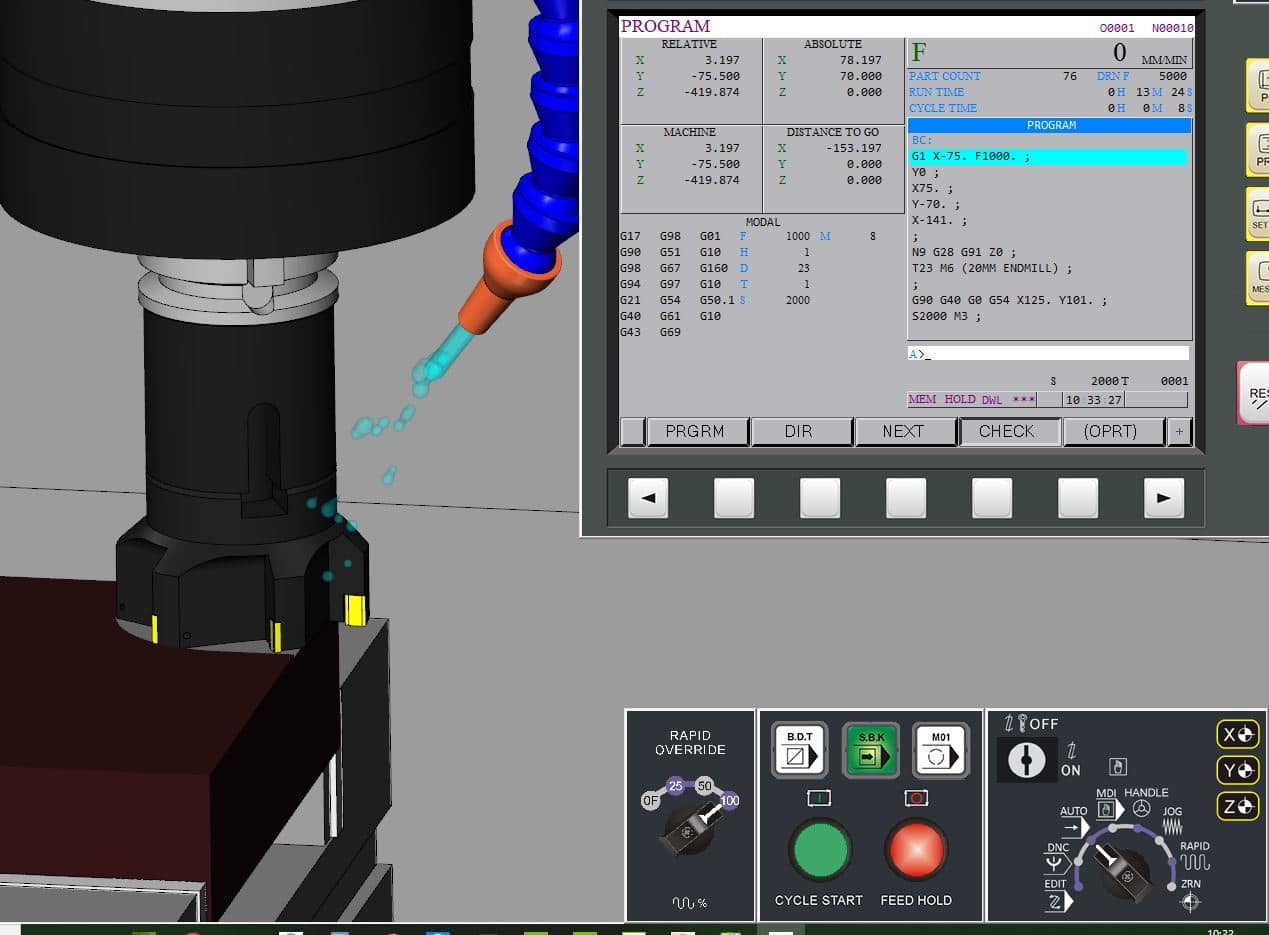
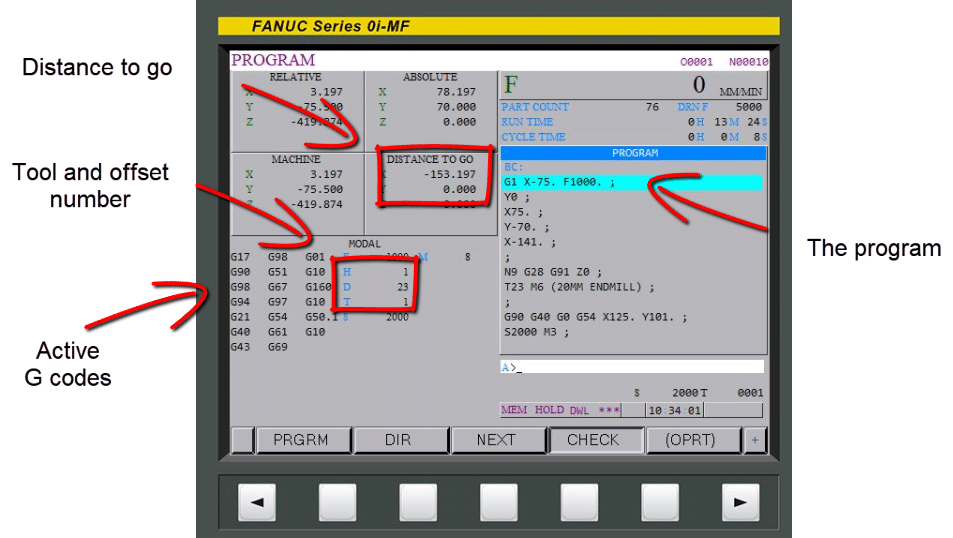
Use your  check screen.

Avoid CNC Crashes

From this you can see all the information you need

Avoid CNC Crashes


Absolute Incremental (Don’t be afraid to use it)

If you use G91 (incremental) make sure you immediately program G90 (Absolute).

To move the tool to the tool change position it is much safer to use G53 Z0 rather than G28 G91 Z0. That way you don’t need to remember to change back to G90.

If you are using a sub-program end it with G90 and begin with G91 that way you won’t forget.

Switch To G90 ASAP

In the parameters of most machines you can set it so that when you press reset the machine will revert back to G90.

Read this on machine wake up state.


G91 is very safe to use if you follow the rules.


Decimal Points

Some controls will take calculator type inputs. X20 will be X 20.00. Beware this can be read as X.020 and there is a big difference.

Fanuc, Haas and Mazak will allow you to set a parameter that allows either.


Read this post first.

Speed Clamps On CNC Lathes (Avoid CNC Crashes)

G50 is really important it should be at the head of every program or possibly on every tool.

G50 S2000 (speed will not go over 2000 rpm)


Avoid CNC Crashes


https://www.youtube.com/watch?v=x14poOHTXlM


Services offered at CNC Training Centre

Edgecam training.

Classroom programmer training.

Onsite CNC Machine Training.

CNC Training on all controls and machines.

Mazak Training Fanuc Training

Don’t forget we offer training on all types of Mazak Machines and all Fanuc Controls 6m to 31i Oi old to young.


CNC Milling Course

Category : Courses Useful Stuff

CNC Milling Course at The CNC Training Centre.

Are you looking to build a career in CNC machining or enhance your existing skills?

At the CNC Training Centre, the CNC Courses are designed to provide hands-on experience.

You get to use realistic CNC machines simulators.

These simulators replicate real-world machining.

Whether you’re a beginner or an experienced machinist looking to upgrade your skills, this course offers a comprehensive learning experience.

CNC Milling Course

Why Choose Our CNC Courses?

1. Hands-On Training with Realistic Simulators

The training centre is equipped with industry-standard CNC milling machine simulators, allowing students to gain practical experience in operating, setting up, and programming realistic machines. You’ll learn everything from basic operation to advanced CNC techniques used in modern manufacturing.

2. Realistic CNC Simulators for Safe and Effective Learning

See what people say.
CNC Training Centre Reviews

Prior to  working on the real machines, students train on highly realistic CNC simulators. These simulators accurately mimic the behaviour of real CNC machines, helping learners understand programming, tooling, and machine movement without the risk of damaging expensive equipment. This makes the learning process safer and more efficient. It also allows the student to experiment if they wish.

CNC Milling Course

3. Industry-Relevant Curriculum

The courses cover a wide range of topics, including:

•CNC Milling Basics – Understanding machine components, safety procedures, and basic operations.

•CNC Programming (G-Code & M-Code) – Writing and editing CNC programs to control machine movements.

•Tooling and Work holding – Selecting the right cutting tools and securing workpieces properly.

•Basic Measuring equipment used in machining. introduction to drawings and tolerances

•Machine Setup – Practical skills for setting up a CNC machine and diagnosing common problems.

“Read More”

Haas Spindle Warm Up Macro

Call David: 07834 858 407


CNC Training Centre Reviews

30 five star ratings on Google

Warm up Programme

Haas Spindle Warm Up MacroHaas Spindle Warm Up Macro

This Haas Spindle Warm Up Macro is something I created recently for the Macro training course that we offer at the CNC Training Centre. The course covers Macro Programming suitable for Mazak, Haas and Fanuc.

This course will be available online soon.

Please fill out the enquiry form on the right if you are interested.

I must admit I often think that where Macro programming is concerned, a little knowledge is a dangerous thing. I just think it’s more about a programmer’s ego than really getting good code.

This article gives a brief description of macro programming if you just want the Haas Spindle Warm Up Macro then jump to the end and copy it. I won’t be offended, honestly.

Be Careful What you Wish for.

Gratuitous use of macro programming , can be dangerous and very confusing to the operator using it.

If you don’t know what gratuitous means don’t worry neither do I, I just heard a bloke say it on the telly.

  • Using a macro can automate a regular task.
  • Families of parts can be grouped together in one programme.
  • All macros need to be “fool proofed” you must add alarms to protect from erroneous input.
  • Use parameters to lock and protect your macro programmes.
  • Macros can be aliased to G and M codes.
  • Don’t reinvent the wheel every day, just use a macro.
  • Don’t forget to check if you have the macro option on your machine it can be quite expensive to add on.

This macro (Haas Spindle Warm Up Macro) is for the warming up of the spindle on your Haas machine.

It does not take big leaps in speed so it’s smoother and more gradual.

Set the maximum rpm you want to warm up to and the time you want the warm up to run for. You also set the initial speed you want your spindle to start at from cold. Also give it the amount the speed increases per step.

It will calculate the difference between your start speed and your maximum speed. Then it divides this speed by the speed increment that you give it. From this it will know how many times to loop.

Once in the loop it uses the machine timer #3001. It zeros the timer then runs it for the calculated time each step.

Time needs to be set in milliseconds because that’s what the geeks use in these machine timers, so it multiplies by 60,000.

Ideally I suggest you alias it to an M code.

Alias what the fuck is an alias?

No it’s not like changing your name from Reginald Kenneth Dwight to Elton John no no it is a bit more sophisticated.

What does Alias mean.

It means you can access a programme using your own G code or M code.

Mazak Spindle Warm Up Macro

So for example see above. If you put 201 into parameter 91 when you programme a G201 it enters programme 9010. Like programming M98 P9010 or G65 P9010. With a G code you can pass arguments to the programme a bit like G81. In G81 you tell it the depth and rapid point these are the Z and the R values. These are called arguments. So now you can do the same with your very own G code.

G81 G98 Z-10. R1. F100.

Also for parameter 81 (see above) if you put 33 into parameter 81 when you programme M33 the control will jump into programme 9000. You cannot pass arguments when you use an M code. Best not to argue then, I say.

So for my Haas Spindle Warm Up Macro we will use M33 and alias it to programme 9000. So having done all this you can lock out programme 9000 so no one can even see it. (It can be our little secret). They will not be able to edit or delete it either.

All they need to know is that M33 will run the Haas Spindle Warm Up Macro.

M33 is aliased to O9000

A word about testing.

When you test your macro you don’t want your control to look ahead.

Why Does Your Programme Need to Look Ahead?

Let’s talk about cutter compensation:

Below is a tool path where the tool is compensated to the left. To machine the part without cutting into it the control would need to read in front.

Mazak Spindle Warm Up Macro

It moves up the left hand side so it needs to know where its going in advance, moving round the outside in single block it would stop here.

Mazak Spindle Warm Up Macro

If it were about to cancel compensation it would end here.

Mazak Spindle Warm Up Macro

If it were about to go left on the inside it would stop here.

Haas Spindle Warm Up Macro

They would all be the same Y position but in single block it would stop in three different places.

So this explains why the control needs to look ahead. Each move relies on the next one for it’s positioning.

When we write macro programmes and are testing them this look ahead can be a real pain in the arse. You see the system often will know the answer before you think it has seen the question.

Complicated? Read on, I meant to confuse you so it makes me look intelligent.

Please Explain

Right , what we do is to use a G code that will stop the system from looking ahead. We can then single block through our macro and check the calculations as we go.

When we are happy with the code we can let the system look ahead again by turning look ahead back on.

Although what you are doing may be very simple in terms of calculations a very simple mistake can really bugger things up.

Be very systematic in your approach and test each section of your macro as you go. As you are happy that each line works move on to the next.

Try my Haas Spindle Warm Up Macro below. Turn off the block look ahead and the single block restriction and check each variable as it changes. It will help you to understand how the Haas Spindle Warm Up Macro works.

One other thing, plan your macro before you start don’t get too excited and rush on. Keep a record of what variables you have used so you don’t accidentally use a variable twice. Things can get very messed up if you do.

Comment, comment, and more comments to say what the comments mean. You can’t have too many comments in a macro. The best approach is to imagine you were abducted by aliens. Will anyone understand your code if they don’t bring you back to Earth?

If you are like me and you have the memory of a goldfish then you will need them for yourself when you look back at this macro in years to come.

Check out this fantastic article on how to lay out your CNC code and comments.

“The code, give me the code?”  you ask.

OK OK.

So here is my Haas Spindle Warm Up Macro.

Hope it is useful to you.

PLEASE DO NOT USE THIS MACRO IF UNDER 18 OR OF A NERVOUS DISPOSITION

Mazak Spindle Warm Up Macro

Oh by the way if you get bored easily then don’t read all this shit. Just put the code in your machine and enjoy it with my compliments.

Haas Spindle Warm Up Macro

O09000 (Haas Spindle Warm Up Macro)

G103 P1 (NO BLOCK LOOK AHEAD)

#3004= 7 (OVERRIDE CONTROL NOT ALLOWED)
#100= 20. (TIME)
#101= #100 * 60000. (TIME MILLISECONDS)

#102= 500. (RPM FROM COLD)
#103= 7000. (MAX RPM)
#104= #103 – #102 (RPM INCREASE)

#105= 1. (RPM STEP)
#106= #104 / #105 (LOOP)
#107= #101 / #106 (DWELL)
M03 S#102 (Start spindle at initial speed)

WHILE [ #106 GT 0 ] DO1 (DO LOOP)
S#102 (START SPINDLE AT INCREASED RPM)
#3001= 0 (RESET INTERNAL TIMER TO ZERO)

WHILE [ #3001 LT #107 ] DO2
END2

#106= #106 – 1 (COUNTER DECREASES BY ONE)
#102= #102 + #105 (INCREASE SPEED BY STEP)
END1

#3004= 0 (OVERRIDE BACK ON)

G103 P0 (NO BLOCK LOOK AHEAD)

M30 

Very boring so what does it all mean? You ask.

Explanation of my Haas Spindle Warm Up Macro

O09000 (Haas Spindle Warm Up Macro)

G103 P1 (NO BLOCK LOOK AHEAD)
(This will stop block look ahead)

#3004= 7 (OVERRIDE CONTROL NOT ALLOWED)
(Set this to a 7 to stop override of speed.)

#100= 20. (TIME)
(Total time of warm up in minutes)

#101= #100 * 60000. (TIME MILLISECONDS)

#102= 500. (RPM FROM COLD)
(Spindle will start at 500 RPM)

#103= 7000. (MAX RPM)
(Maximum RPM you want the warm up to reach)

#104= #103 – #102 (RPM INCREASE)

#105= 1. (RPM STEP)
(This in the step used as the RPM increases)

#106= #104 / #105 (LOOP)
(Calculate the number of times it goes around the loop)

#107= #101 / #106 (DWELL)
(Dwell time after each speed increase)

M03 S#102 (Start spindle at initial speed)

WHILE [ #106 GT 0 ] DO1 (DO LOOP)
S#102 (START SPINDLE AT INCREASED RPM)
#3001= 0 (RESET INTERNAL TIMER TO ZERO)

Haas Spindle Warm Up Macro

WHILE [ #3001 LT #107 ] DO2
(TIMER COUNTS DOWN BY DWELL TIME)
END2

#106= #106 – 1 (COUNTER DECREASES BY ONE)
#102= #102 + #105 (INCREASE SPEED BY STEP)

END1

#3004= 0 (OVERRIDE BACK ON)
(Override works again.)

G103 P0 (BLOCK LOOK AHEAD)
(This will put block look ahead back on)

M30

Single Block

You can stop single block from working in a macro.

It is really annoying if you expect your spindle to warm up in 20 minutes. You come back having made tea cos you left the machine in single block.

“Shit” (expletive of your choice) “the machines been on single block and stopped on 500 rpm for 20 minutes”

#3003= 1 (SINGLE BLOCK OFF)

#3003= 0 (SINGLE BLOCK ON)

Stop single block is used in a G84 tapping cycle. There is a thought, imagine using single block when tapping. (You may need to think about that one)

I also have suppressed spindle override because you want the correct speed in a warm up programme. So your override control won’t work until it’s cancelled again at the end of the macro.

Again this is used in G84.

If you read the code and explanations above you’ll see how it works.

Haas Spindle Warm Up Macro

Oh and by the way here is a similar article for a Mazak machine.

Services offered at CNC Training Centre

Edgecam Training.

Classroom programmer training.

Onsite CNC Machine Training.

CNC Training on all controls and machines.

Mazak Training Fanuc Training

Don’t forget we offer training on all types of Mazak Machines and all Fanuc Controls 6m to 31i Oi old to young.


New CNC Machines, Explore the Old One First

Tags :

Category : Useful Stuff

New CNC Machines? Make Use of What You Already Have

CNC Training Call David: 07834 858 407

30 Five Star Reviews

CNC Training Centre Reviews

Contact CNC Training Centre

New CNC Machines

Before you buy any new CNC machines or computer systems checkout what you already have you might be surprised at what you can do. Breath life into the old beast.

Before buying New CNC Machines is there more you can do with the old one.
Mori Seiki Lathe

Investment

About 10 years ago my big gripe with companies when looking at increasing productivity and improving production methods, was that there was little investment in new technologies.

New CNC Machines represent a massive investment
Mazak Integrex Lathe

Now You Have New Machines

I think that now things are a bit different companies have invested in New CNC Machines and computer systems, although there is still room for improvement. Being the grumpy old ageing failed rock star that I am, my moan now is that the technologies that people have invested in are not being used to their maximum capabilities.

New CNC Machines


Bright Ideas

These are some of my suggestions and your MD will love the fact that they all cost little or no money:

  • Read the manuals on your CNC machine just the first few pages (not the boring health and safety shit, the next bit) bet you will learn something you didn’t know.

  • Now, about that probe in the carousel (covered in swarf, shit and coolant) that no one knows how to use. Learn to use it. Come on now there are loads of idiots like me posting free videos on this stuff. Once you use one I will guarantee your life will never be the same.

  • Check out the settings on your Haas machine (I can always get people excited about what these can do) look at the Haas tips n tricks page on their website. You will learn loads of stuff to impress your mates, not at the pub though please.

  • Make sure you are using the latest version of Edgecam (or your chosen CAM system). Edgecam and all software is evolving rapidly and you could be really missing out. If you have a software maintenance contract then you’re pouring money down the drain by not using the support.

  • Try to make a point of learning something new every day. (I am 86 and I still do) write them all in a book so you can look back and use your ideas.

That’s Not All

Check out the options on your machine. Maybe you have some really cool options you didn’t even know about. Might even be worth shelling out a few quid to buy some extras.

  • Rigid tapping.
  • Through spindle coolant.
  • Higher RPM.
  • Macro B.
  • Peck Tapping.
  • Extended work offsets.
  • Extra editing functions.

Watch These Videos

Copy a program on a Fanuc 18i

Copy and paste on Fanuc 18i


Oh and There’s More

If you really want to spend money I can help you with this I’ve already spent nearly all of mine. .

  1. Consider buying a touch probe, they save hours in setting time.
  2. Auto tool measurement probes can be used to set tools automatically. You will also be able to do in program checks for tool breakage etc.
  3. Add Macro B to your Haas or Fanuc control for loads of extra features.
  4. Add a speeder unit to increase maximum RPM.
  5. Consider adding a 4th axis to your vertical machining centre this will give loads of extra capacity and flexibility. Not cheap but well worth it.

But Most Of All Get Us To Train You

Please let me know how this goes, enter your comments below.

Contact me

Please contact me if you require:

  • CNC programming training.
  • Want to learn CNC programming.
  • Fanuc control training.
  • Yasnac programming training.
  • Any type of CNC course.
  • Fanuc training courses
  • CNC lathe training
  • Siemens Sinumerik
  • CNC Vertical Machining Centre training

Services offered at CNC Training Centre

Edgecam training.

Classroom programmer training.

Onsite CNC Machine Training.

CNC Training on all controls and machines.

Mazak Training Fanuc Training

Don’t forget we offer training on all types of Mazak Machines and all Fanuc Controls 6m to 31i Oi old to young.


Careers in CNC

View all current vacancies in CNC

Click here

Call David: 07834 858 407