Month: January 2023

G98 and G99 It’s About Jumping Things

G98 and G99 It’s About Jumping Things

G98 and G99, a canned cycle is usually one line of code for example to drill a hole. This one line of code tells the machine all it needs to know about drilling my holes.

  •  Depth
  •  Feed-rate
  •  A point in the Z axis to rapid to before drilling
  •  Point to rapid back to after drilling
Sample program of G81 Drilling Cycle G98 and G99
G81 Drilling Cycle Sample Program G98 and G99

What happens then is each time you give the machine a new position it will drill one of these holes.

This is great because you don’t have to worry about what’s going to happen.

Each hole will be identical unless you change one of the parameters in the cycle like the Z depth or the feed-rate.

Therefore if on one hole you put a different Z depth that hole and all subsequent holes will be to the new depth.

Easy As ABC

So all in all it’s a really easy way to drill holes. You tell it what you want and then each time you give a position you get a hole. Then when you get sick of drilling holes you type in G80 and it stops drilling holes.

Machine says “OK this turkey doesn’t want anymore holes” so from now on when the machine moves to a position nothing happens.

Mitsubishi Drill In Action G98 and G99
Mitsubishi Drill In Action

Mitsubishi Carbide

There are loads of Canned Cycles I can’t be bothered to tell you about them all cos I’m going out tonight otherwise I would explain them all. If you scrat around this website for a while you’ll find them all.

Anyway they all do different shit.

They all work in the same way but with some variations.

Now the video at the bottom of the page is about G98 and G99.

G98 and G99 are in all of the drilling and tapping cycles. You have one or the other. You can even miss it out if you can’t be arsed with it.

OK so assuming I want it, what does it do?

You may well ask.

I know for a fact that some of you, and I won’t mention names, put this on the line with the canned cycle but you ain’t got a clue what it does. Maybe you don’t even put it in because you’re frightened of what it might do..

Now’s the time to learn or you will have it on your conscience for the rest of your life.

By the way if you don’t give a flying shit what it does then I wouldn’t waste anymore time reading this.

Here is a lovely video on kittens for you to watch. Off you go.

G98 and G99 How it works.

If you prefer  dogs read on.

  1. First of all the tool will rapid to what we call an initial point which the control remembers ready in case you decide to program G98. (This is the last Z move you made before the cycle is called).
  2. The tool will then rapid down close to the hole (this is called the R point). Don’t make this too far away or you will waste movement.
  3. Tool feeds down in Z to the Z depth at the feed-rate you specified.
  4. Then the tool will rapid back out of the hole. It can either rapid out to initial point (1) or the R point (2) depending on if you programmed G98 or G99.
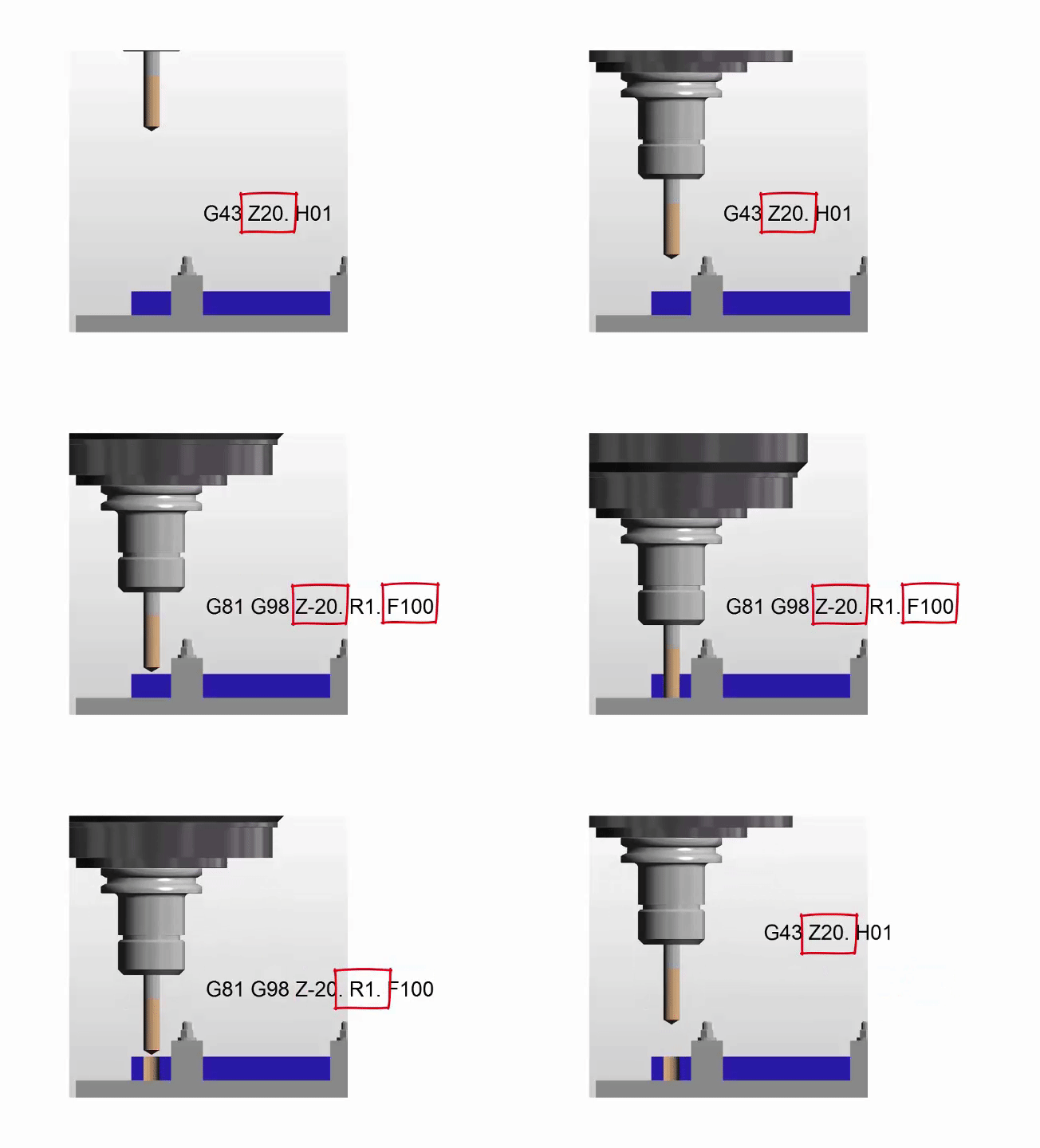
Parts of the G81 drilling cycle with G98 and G99
How G81 works in action

Now if you program G99 it returns to the R point (2)
If you program G98 it returns to the initial point  (1)

OK why on earth would I want that? Maybe you wish you had chosen to watch the kittens video, but read on.

Well……. if you made that initial point 50mm above the job (about 2 inches) and the rapid point was 1mm above the job (.040 inches).

You could drill all your holes in G99 and the drill would each time return to 1mm (.040 inches) above the part.

If you add a clamp to jump over just put G98 on the hole before and it will jump to 50mm (2 inches) above the part. Oh and it misses the clamp.

Change back to G99 and it stays down returning to 1mm (0.040 inches) above the part.

Admit it, you like it don’t you?

Please don’t try this at home by the way.

Get it? So you eliminate wasted moves. Good init.


demonstration of G98 and G99 in action
G98 and G99 in Action

Oh and here is my video it explains how to use G98 and G99 to jump over clamps on a fixture.

The video is shit by the way but I had to learn (it’s been ages ago).

If you are completely crazy and you like this video, please don’t forget to subscribe to my YouTube channel by going to: CNC Training Centre

Please contact me if you require:

  • CNC programming training.
  • Want to learn CNC programming.
  • Fanuc control training.
  • Yasnac programming training.
  • Any type of CNC course.
  • Fanuc training courses
  • CNC lathe training
  • CNC Vertical Machining Centre training
  • Siemens Training
  • Hatha Yoga
  • Flower arranging

Services offered at CNC Training Centre

Edgecam Training.

Classroom programmer training.

Onsite CNC Machine Training.

CNC Training on all controls and machines.

Mazak Training Fanuc Training

Don’t forget we offer training on all types of Mazak Machines and all Fanuc Controls 6m to 31i Oi old to young.


Rigid Tapping G84 Canned Cycle

Rigid Tapping G84 Canned Cycle.

Let’s face it tapping on a CNC Machine can be a “right pain in the arse” as we say in the Midlands. But help is at hand. All you need is a bit of knowledge and the right equipment and it’s a dream, an absolute pleasure.

Rigid Tapping G84 Canned Cycle

What is Rigid Tapping?

You mean you didn’t know? Well the first step is admitting you didn’t know.

Rigid tapping means the tap can remain rigid throughout the tapping cycle. It can be held in a chuck just like an endmill or a drill. The machine spindle locks in with the feedrate just like when you are screw cutting. You can buy tapping heads specially for this. They are no different to holding in a chuck but you get to use collets for holding the tap. These make it easy to change and it can’t spin.

Oh and you don’t need to remeasure the tap if you replace it.

Rigid Tapping G84 Canned Cycle

So What Use Is This You Say

Well here are some of the advantages.

  1. No need for expensive tension and compression tapping heads.
  2. You can control the depth of the thread very accurately.
  3. It is ok to re-tap the same hole if it needs to be deeper.
  4. Peck Tapping of difficult materials is possible (Yes there is such a thing).
  5. Quicker set-up times.
  6. Feed is the same as the tap pitch.

Rigid Tapping G84 Canned Cycle

But There’s a Catch

It’s an option. Sorry you might not have it.

Most modern machines do have Rigid Tapping as standard but the older the machine the less likely it is that you will have it.

Sorry but you need to look in those boring manuals.

Rigid Tapping G84 Canned Cycle

Rigid Tapping G84 Canned Cycle, Fanuc, Haas, Mazak.

T06 M06 (M10 x 1.5 Tap)

G90 G0 G54 X50. Y50. S300 M03
G95 (Feed per rev)
G43 Z3. H06 M08
G84 G98 Z-15. R1. F1.5
X75.
X100.
G80

On some Fanuc controls you will need M29 for rigid tapping.

T06 M06 (M10 x 1.5 Tap)

G90 G0 G54 X50. Y50. S300 M03 (S300 M03 Optional)
G43 Z3. H06 M08
G95 (Feed per rev)
M29 S300
G84 G98 Z-15. R1. F1.5
X75.
X100.
G80
G94 (Feed per minute)

Just another interesting note (Read This G98 G99)

In the above cycle the tap will rapid down first to Z3. as in the G43 line. On beginning the cycle it will then rapid to what is know as the R Point. In this case R1. (one mm above the hole).

It will tap to a depth of 15 (Z-15). Depending on whether you programme G98 or G99 it will return to either the Z3. or the R1. before moving to the next position.

If you want to know more about G98 and G99 then read the article above.

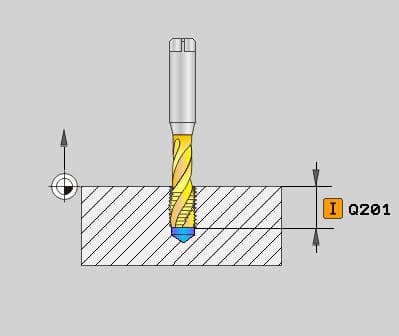
Heidenhain Uses Cycle 207

Rigid Tapping G84 Canned Cycle


Rigid Tapping G84 Canned Cycle

Oh! And did You Know This??

G94 feed per minute (feed is in mm per minute).

G95 feed per rev (feed this amount every revolution)

These two G codes are your friend when you’re tapping or should I say G95 feed per rev is your friend.

Why?

When Rigid Tapping G84 Canned Cycle on a Fanuc, Haas, Mazak or similar control it is best to use G95. This means that when you programme your G84 (Tapping Cycle) your feedrate is your pitch.

The really great thing here is that if you change the speed of the tap you don’t change the feed because it’s the pitch.

Bet you have made that mistake before???
You change the speed and forgot to change the feed. We all know what happened next.

How easy is that?

Oh and don’t forget to change back to G94 at the end of the tapping.

You will notice the Heidenhain does this automatically for you.

Rigid Tapping G84 Canned Cycle

On Machines Like The BMC 800 from Toshiba

This machine has the Tosnuc 888 control.

T06 M06 (M10 x 1.5 Tap)

G90 G0 G54 X50. Y50.
G43 Z3. H06 M08
G95 (Feed per rev)
M05
S300
M843 (Synchronous Rotation command)
G84 G98 Z-15. R1. F1.5
X75.
X100.
G80
M845 (Cancel Synchronous Rotation command)

When you don’t have rigid tapping you need a tapping head like this.

Rigid Tapping G84 Canned Cycle

Notice how it pulls out when the tap stops and reverses.

Ok So what’s Going on Here?

  1. Let’s tap a hole.
  2. Start spindle forward.
  3. Feed to depth at correct speed.
  4. Stop spindle (tap starts pulling out).
  5. Reverse spindle (tap pulls out a bit more).
  6. Start spindle (Needs to reach speed).
  7. Feed out of hole.

So the problem is that when the spindle stops, reverses and starts up everything goes wrong.

But this tension and compression tapping head can take up all the slack.

Not An Exact Science.

Definitely not, depths will vary. You will probably need to do some hand tapping too.

Tapping Clutches

These are special collets designed to slip at a certain torque. This allows you to get to depth without breaking the tap.

Rigid Tapping G84 Canned Cycle

You adjust the collar at the front to give the required torque.

You can’t use these on Rigid Tapping G84 Canned Cycle because the last thing you want is for the tap to stop rotating.

Haas Have The Answer

Rigid Tapping G84 Canned Cycle, check out this great video on how to stop the machine half way through tapping.

Recover it without busting the tap!!

Ok So Let’s Talk About Peck Tapping

Fanuc (if you have the option) is G84.2 just programme your normal tapping cycle but replace G84 with G84.2 and add a Q value which is your pecking depth.

G84.2 G98 Z-15. Q5. R1. F1.5

Why would one want to peck tap?

  1. Holes that clog with swarf.
  2. Difficult materials.
  3. To impress visitors.

Don’t Have It? Don’t Despair You Don’t Need It if You have Rigid Tapping

If you programme this.

G84 G98 Z-5. R1. F1.5
Z-10.
Z-15.
Z-20.
G80

There you have it Peck Tapping.

So you move to a position and it taps a hole 5mm deep. Because you are in a canned cycle it will repeat the procedure at Z-10. Z-15. and Z-20.

How cool is that?

Thanks For Reading

Don’t forget there’s loads more folks.

And a YouTube channel

Contact Me

Services offered at CNC Training Centre

Edgecam programming and training.

Classroom programmer training.

Onsite CNC Machine Training.

CNC Programming and Training on all controls and machines.

Mazak Training Fanuc Training

Don’t forget we offer training on all types of Mazak Machines and all Fanuc Controls


CNC Milling G02 G03 to Mill a Full Circle

CNC Milling G02 G03


CNC Milling G02 G03

To produce a full circle on a Fanuc or Haas G code type programming system is really easy.

Last week I was training four very experienced programmers and I asked them how they would programme a full circle.

The answers they gave shocked me, I had to take out my hip flask and drink a large shot of brandy.

What they were doing was perfectly correct but definitely not the simplest way.

One said he broke the circle into two halves. One said he copied some code he already had in the machine. The other one said he got the bloke who did it in two halves to do it for him. Oh and the other one used I and J and X and Y.

OK so just imagine you want to mill internally around a 40mm diameter circle.

Training Courses Let Me at Em

CNC Milling G02 G03 to Produce a Full Circle, here’s the code.

First in two halves

G0 X0 Y0 S1500 M3
G43 Z3. H01 M8
G1 Z-5. F100.

G41 X20. Y0 D1 F200.    (Apply Cutter Compensation)
G3 X-20. R20.                   (First Half)
X20.                                     (Second Half)
G1 G40 X0 Y0                   (Cancel Cutter Compensation)

G0 G53 Z0

All in one complete with wasted Code

G1 G41 X20. Y0 D1 F200.
G3 X20. Y0  I-20. J0 (Mill Full Circle)
G1 G40 X0 Y0

But this is really all you need

G1 G41 X20. Y0 D1 F200.
G3 I-20.         (Mill Full Circle….. Sooo Simple)
G1 G40 X0 Y0

Remember that song by the Average white Band “Let’s Go round Again”? I used to love it.

Actually I still do, as an old twat I’m allowed to like this shit.

Ok let’s go round again. It’s so easy and it saves leaving a mark.

G1 G41 X20. Y0 D1 F200.
G3 I-20. (Mill Full Circle)
I-20.        (Lets go round again)
G1 G40 X0 Y0

Now if you have a Toshiba with Tosnuc control or Haas or maybe a Yasnac CNC control…..

CNC Milling G02 G03 to produce a full circle you just need this:

G13 D1 I20. F200. (Everything all in one)

                G13 (Counter Clockwise) G12 (Clockwise)
                D1 (Use offset 1)
                I20. (20mm Radius)

G13 does everything. It’s the an all inclusive holiday of circular milling except you don’t gain weight and you’re not pissed everyday.

How cool is that and you even get a tangential approach. At my age you’re glad of all the tangential approaches you can get.

No there is no sexual innuendo here it just means you approach the circle using a circular move. You sort of creep up when it’s not looking.

Know what I mean??

Here is a nice picture to demonstrate.

CNC Milling G02 G03

Think about it, why would we do this?

Well the older and more inaccurate your CNC machine is the more likely it is that your machine will leave a mark at the entry and exit point. This is also dependant on the material and the size of the cut you are using.

A quick workaround for this is to just go round the circle twice (let’s go round again). It very often does the trick.

CNC Milling G02 G03

Oh by the way if I saw a tangential move that big I would think it was a wasted move. (It’s just to demonstrate). You only need a short tangential move to do the job.

The easiest way to programme a tangential approach is like the ones above. Coming in from North, South, East or West on the compass.

Now look at this.

CNC Milling G02 G03

This is the best way, although it’s more difficult to programme.

I think it’s South West on a Compass?? 


The reason is that there is no axis change of direction and no animals are injured or hurt in any way during the process.

If you watch the movement above and watch carefully what the X axis is doing. It changes direction before it is in contact with the circle. And the same thing on the way out of cut with the Y axis.

Direction Change When Using G02 G03 to mill full circle

When milling a full circle each time an axis changes direction there is a chance you will be left with a visible mark on the circle. These points are North South West and East on a compass.

Watch below to see where these points are. If you have a new machine there should be no visible mark on this change of direction.

On an old machine this can be really noticeable and cause real problem.

CNC Milling G02 G03


Circular Motion and Skid Marks

If you have an old machine you will know what I mean. Those little annoying marks where the machine changes direction. If CNC Machines were underpants then these would be the skid marks.

For my American readers in the UK we call those annoying brown marks at the back of your underwear skid marks. I don’t think you get them in America.


I have been working on a 12 year old Mazak Horizontal machine recently and was amazed at just how good a circle it produced. It beats the shit out of using a reamer. Oh and you can easily adjust the size with your D offset.

CNC Milling G02 G03

Just a note. If you do use circular milling to produce a bore just remember that if your cutter is not parallel then your bore won’t be either. So don’t use that crappy old re-ground cutter. Try n get the boss to buy you a shiny new one.


CNC Milling G02 G03

oh and just one other thing………..

Measure the bore at the top and the bottom.

Simple Full Circle Programme

G1 G41 X20. Y0 D1 F200.
G3 I-20.     
G1 G40 X0 Y0

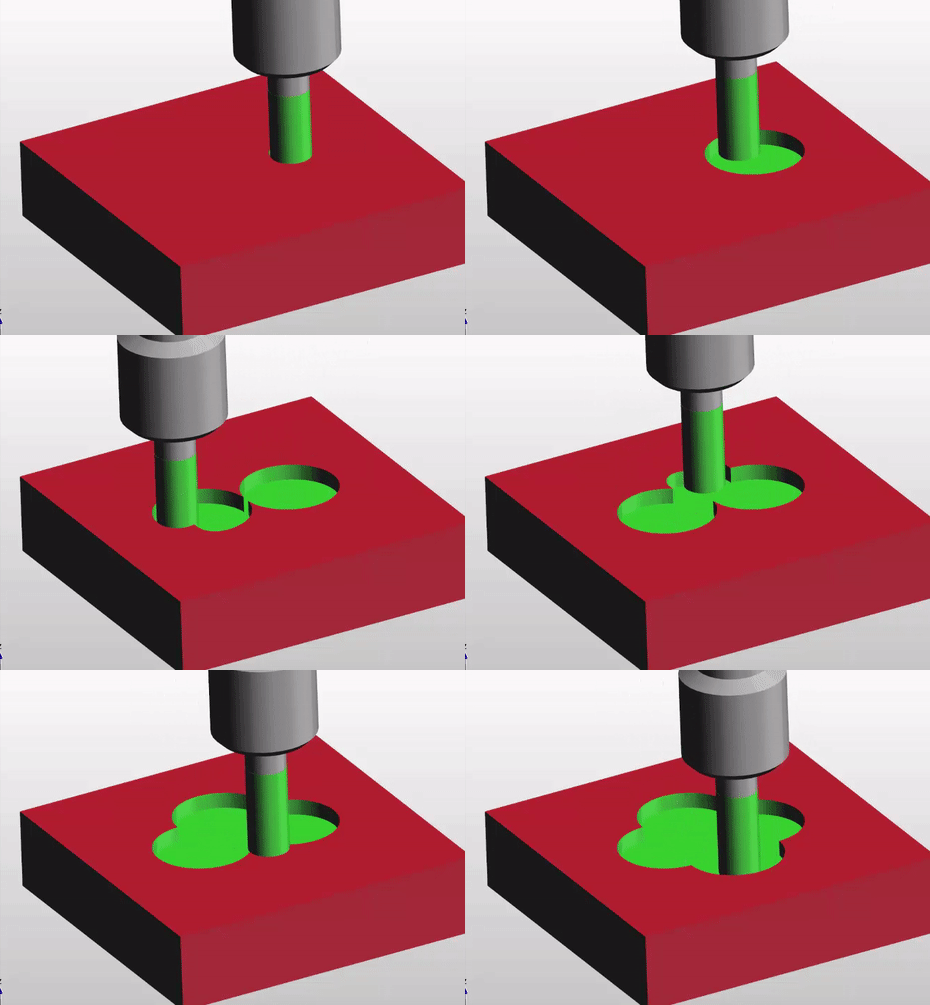
There are actually four choices which produce four totally different circles.

And potentially a scrap part. So use those machine graphics to check your code if you got em!!

CNC Milling G02 G03

G3 I-20.    (The one on the left and the one we used)

G3 I20.     (The one on the right)

G3 J20.    (The top one)

G3 J-20.  (The bottom one)

Here They Are In Action

CNC Milling G02 G03


CNC Milling G02 G03

Click for More on G02 and G03

If you want to do this on a Sinumeric Siemens 840D read this

Thanks For Reading

Don’t forget there’s loads more folks.

And a YouTube channel

Call David

Learn CNC Programming

Services offered at CNC Training Centre

Edgecam programming and training.

Classroom programmer training.

Onsite CNC Machine Training.

CNC Programming and Training on all controls and machines.

Mazak Training Fanuc Training

Don’t forget we offer training on all types of Mazak Machines and all Fanuc Controls 6m to 31i Oi old to young.


CNC Applications Engineer

Category : Useful Stuff

CNC Applications Engineer

When I was younger the job I really aspired to  was a CNC Applications Engineer.

Actually it’s not really true because being a part time rock singer I obviously wanted success from that but let me describe that as more of a dream. Oh and I don’t think you can describe being permanently pissed, incredibly wealthy and shagging all day as a job.

Anyway I will not digress.

I didn’t actually have a CNC application engineer job description but whenever I got to work with these guys I was in awe of them.

(I just realised I didn’t know the difference between ore and awe)

I remember being trained by a guy from Hitachi Seiki

They were a top class company with some amazing machines that are still around today.

They were taken over  by Mori Seiki in 2002 after going into bankruptcy.

Company Car Wow

The guy training me was Clive and he was and still is a very talented engineer. We got on great and I still talk to him sometimes to this day.

I thought how great it must be to travel all over the country staying in nice hotels. Oh and he had a company car.

Ford Sierra Estate car from the 1980's
Thanks to Simon Classic Car Auctions


I could have sworn Clive had a Sierra but in fact I just messaged him and he said it was a red Ford Escort. Just like this, I don’t know if he had his name across the top of the windscreen.

Red Ford Escort
Red Ford Escort

Now you might be thinking that I must have been easily impressed but these cars really were the dog’s bollocks in those days.

Dog’s bollocks what does he mean?

The job we were doing was a turned part for a fork lift truck and we had one of the very early robot loading arms.

This was around 1985 so they’ve been around longer than you think.

CNC application engineer job description


I remember he had a really methodical and systematic way of doing things and the final part was perfect.

By the way if you ever work with robots you need to be really precise in the way you do things.

His approach has stuck with me to this day and I still try to work that way. I mean it’s easier when you are old like me to not rush. But this is not bullshit because I can’t sprint round the block like I used to.

It’s a bit like driving fast I drive slow because, although it took several years to realise this, no one tends to die.

It’s not because I can’t drive fast.

I mean if I had one of these I might be tempted

CNC Applications Engineer

What do they actually do?

Here is a kind of CNC application engineer job description

Shit loads

So it’s any or all of what is listed below.

  • Commission Machine.
  • Write CNC code long hand.
  • Design and manufacture fixtures and tooling.
  • Setup machine.
  • Prove-out programs.
  • Check the parts and get final approval from quality department.
  • Train the operators.
  • Train programmers.
  • Make tea.
  • Program using a CAD/CAM system.

Interested?

A lot of what a CNC applications engineer does could be described as Production Engineering.

I did have to google Production Engineering to see if I had it right. It seems I might not have but to be honest who gives a flying fuck.

Production Engineering to me is controlling or doing the whole process of getting a new part produced. From design of work holding right through to final inspection.

That’s why being a CNC Applications Engineer was always so appealing to me because it’s never boring.

So How do You Get There?

Well the answer is it takes time, years in fact.

Oh and did I mention you have to be good.

Now this article is not meant to be a plug, but we do offer courses to help you keep moving up to the next level in your engineering career.

“Come on Dave you lying bastard what are all these links to courses for if you’re not plugging?” you may say.

I’m not answering that because I keep telling you not to call me Dave, it’s David.

CNC Operator (Step 1)

(One up from making the tea)

  • Pressing the button.

Production Engineering

  • Cleaning the parts.
  • Removing sharpe edges from the parts.
  • Checking the parts.

You could end up doing a lot more than just pushing buttons. Rather depends on the company you work for and your attitude.

Show your interest and gently push to do and learn more.

CNC Machine Setter Operator (Step 2)

  • Setting tools.
  • Setting datums.
  • Prove out programs.
  • Altering wear offsets.
  • Changing worn or broken tools.
  • Maybe minor program alterations.

Try to learn as much programming as you can in this role. Watch the machine and the program and try and link the two together.

Programmer Setter Operator (Step 3)

Write your own program on the machine as well as all of the above.

Don’t forget the real engineering is knowing how the tools perform and really understanding the work holding.

Programmer (Step 4)

Programming on or off the machine progressing to learning a CAD/CAM system like Edgecam

This is where you get to create potential havoc and break loads of tools.

CNC application engineer job description

Production Engineering (Step 5)

  • All of the above
  • Finding suitable tools and buying where necessary
  • Designing and managing work holding

In this role it’s difficult to know exactly what your company will ask of you. It varies massively from one company to another.

CNC Applications Engineer (Step 6)

Come on concentrate I already told you this earlier in the article. Go and watch some fast cars on YouTube you obviously are not concentrating.

Normally as a CNC applications Engineer you would d be working for one of the big machine tool companies or one of their dealers.

I think if I had my time again I would have tried to work for them all. I have worked independently now for much longer than I would care to mention.

OK I’ll care to mention, nearly 30 years.

You Might Not Settle

Even if it’s not the job that you think you’d like to stay in forever it would be a massive stepping stone for other things.

Every step of the way:

  • Be confident.
  • Tell the truth about your achievements.
  • Learn as much as you can.
  • Ask loads of questions.
  • Treat everyone with loads of respect even when they don’t deserve it.
  • Never ever bullshit your way into a job, it usually ends in tears (probably yours)
Never bullshit your way into a job.

Why on Earth would you want to Become a CNC Machinist??

Category : Beginners New Stuff

If someone asked me why I wanted to be an engineer I’d have to be honest and say I don’t know why?

In actual fact it was because I knew I didn’t want to stay at school. They were still a little cross about me putting bromide in the flapjacks and shitting in the glove compartment of the headmasters Reliant Robin.

Anyway my dad was an engineer (Capstan Setter Operator)

Oh and I’d done metalwork at school. So I thought “fuck it” let’s have a go.

I applied for a few jobs in Coventry which was the manufacturing capital of the universe in those days.

I ended up at Rolls Royce. Anyway I’ll cut this short because I hated it with a screaming passion.

Bearing in mind this was in the days when kids obeyed their parents, so I could not leave before I completed my apprenticeship.

A little footnote here, my parents were real nice people but as was the practice in those days, they tended to beat the livin’ shit out of their offspring for the tiniest of misdemeanours.

What I mean is I’m sure that had a bearing on things.

Anyway I’d discovered rock music and I wanted to be a Rock star. What attracted me to this was the fact that they seemed to be shagging all the time and spending loads of cash.

I hadn’t done much of either of these things yet but relished the idea of trying.

My mate happened to mention that I was a good singer cos he heard me singing along to the radio so he gave me a job in his band as lead singer and front-man.

From this point onwards I was hooked. My first band was called RIP and we were shit.

We didn’t know we were crap so we forced our music onto our poor innocent unsuspecting audience’s night after night.


At one such gig I was spotted by a professional band who offered me a full time singing job for more money than I could spend.

It transpired that it was my band that were shit and that I was a half decent singer.

The old man went fuckin’ bonkers and said I couldn’t leave Rolls Royce.

As I was very close to the end of my apprenticeship and after many arguments he let me leave once my apprenticeship was over.

I managed to stay professional as a singer working in nightclubs all over England for the next five years.

I loved it and made good money but couldn’t help thinking their was more.

Soon, there was more, I got offered a job as a backing singer for a 70’s pop star.

This job turned out to have it’s perks but I soon found myself constantly on tour without a pot to piss in.

I left and went back to the nightclub scene.

Soon potential bullshit fame came knocking again when I was offered a job in an established rock-band. They had already had a few mildly successful records under their belt.

They had toured the world supporting the likes of AC/DC and Black Sabbath to name a few.

Completely sucked in by all this I joined, convinced I’d be living the rock n roll life style as soon as the next album was released.

It’s a long story but I ended up skint and never finished the record.

Fanuc Yellow Manuals Saved My Life

I knew I had to work because by now I had a wife and a son who needed a place to live and food.

My only option was to go back to Engineering. I think at the time I would rather perform my own appendectomy than return to that environment.

I removed my appendix and once I recovered started applying for jobs. Surprise Surprise I got them all.

This was because I had done my apprenticeship at Rolls Royce. I always went on to explain to my future employers that I was basically a fuckin idiot but they were so impressed by the Rolls Royce pedigree they still wanted me.

Two Hundred Quid a Week

They stuck me on a Horizontal milling machine and although I say it myself I was good. Soon I got on Bridgeport BRJ’s and stuff and I was doing well. I was working probably 70 plus hours a week and couldn’t believe how much cash I was making sometimes as much as £200.

Soon I started working as a singer in my spare time but it didn’t help being torn between two cultures.

It resulted in my often not turning up for work after a late night with my band.

Happy Birthday

I was my birthday just after Christmas.

I’m not telling you the date because I will probably be inundated with birthday cards and someone will steel my identity only to find they are worse off than if they had kept their own.

The boss called me into his office “David” he said “the other two directors have advised me so sack you”.

It was like the good news bad news thing.

“Anyway I have decided not to”.

(Sorry I cant keep doing the speech marks thing so I’m going to tell you what he said.)

What he told me was that he wanted to try me on the CNC Machines because he thought I’d be good at it. He did add that it was definitely my last chance. That’s where it all began.

Fanuc Yellow Manuals Saved My Life

I know I’ve used that title twice (I’ll have the S.E.O. police on my back), that’s an in joke if you know about search engine optimisation.

Anyway these manuals really did save me.

The machine they started me on was a Matsuura 710 with a Fanuc Control.

I was hooked. I just loved it so I took the big thick yellow manuals home and studied them.

While I was at work I constantly watched what the machine was doing and compared it to the program. I then checked it all out in the Pidgin English manual and made sense of it.

Picture of a Pidgin

The manuals were really shit in those days. They were really badly written and some times just wrong.

So while the other operators were reading the Daily Mail, scratching their arses and developing right wing, racist views. I was rapidly learning how to set operate and program CNC machines.

Every time my boss got a new machine guess who got to go on it?

Two years on I was running the whole CNC department. I had my own great big yellow Fanuc computer to program on.

I have continued to be fascinated by CNC machines to this day, that’s about forty years.

For the last twenty five years I have had my own business training people on CNC Machines.

I have had the pleasure of being involved in loads of exciting projects from making moulds for Viagra Pills to cutting Weetabix to writing macros to make wedding rings.

I still do loads of music and recording and all sorts of stuff but the mic I prefer to be holding is this one


Careers in CNC

View all current vacancies in CNC

Click here

Call David: 07834 858 407