When you work on a machine day after day or you work on the same CAD system. I believe that every now and then you need to look at what you are doing and take stock. You know like when you can’t quite get something to work correctly and you find a way to frig it.
Well done you got yourself out of a mess. But hang on a minute that was two years ago. So when you gonna take the time to find out what was the correct way?
It’s time to get off your fat arse and do something about it.
Sometimes when I am training people I feel like I am being really fussy when I pick them up on minor annoying things they do when operating a machine. By the way I don’t mean things like scratching your bollocks.
Right, your on a Fanuc or Haas control and you want to call program one and you type in O0001 and press search or lower cursor.
No no no!
Just type in O1 that’s all you need. Honestly it drives me bloody bonkers.
Here is an idea just spend one day sorting all these little things out. I tell you now the saving over a year, once you force yourself to do everything the quick way, is massive and it’s there forever.
There is a slow convoluted way and there’s a right way.
Check out the shortcut keys on your favorite bit of software and use em. It’s amazing once you get a grip on it.
How do you copy and paste? You can let me know on that one.
Anyway Enough Ranting This is The Post
Just an address will do when you are typing code into a Haas control. You don’t need to type the zero. How cool is that?
Impress your mates with this one, or better still the boss (you may get a raise……. not)
Type in G X Y and press input. (This could be in MDI or EDIT mode)
Yes that’s all you need.
It will go in as G00 X0 Y0
These clever Americans can just guess what you are trying to do.
So much easier, one day all controls will be this good.
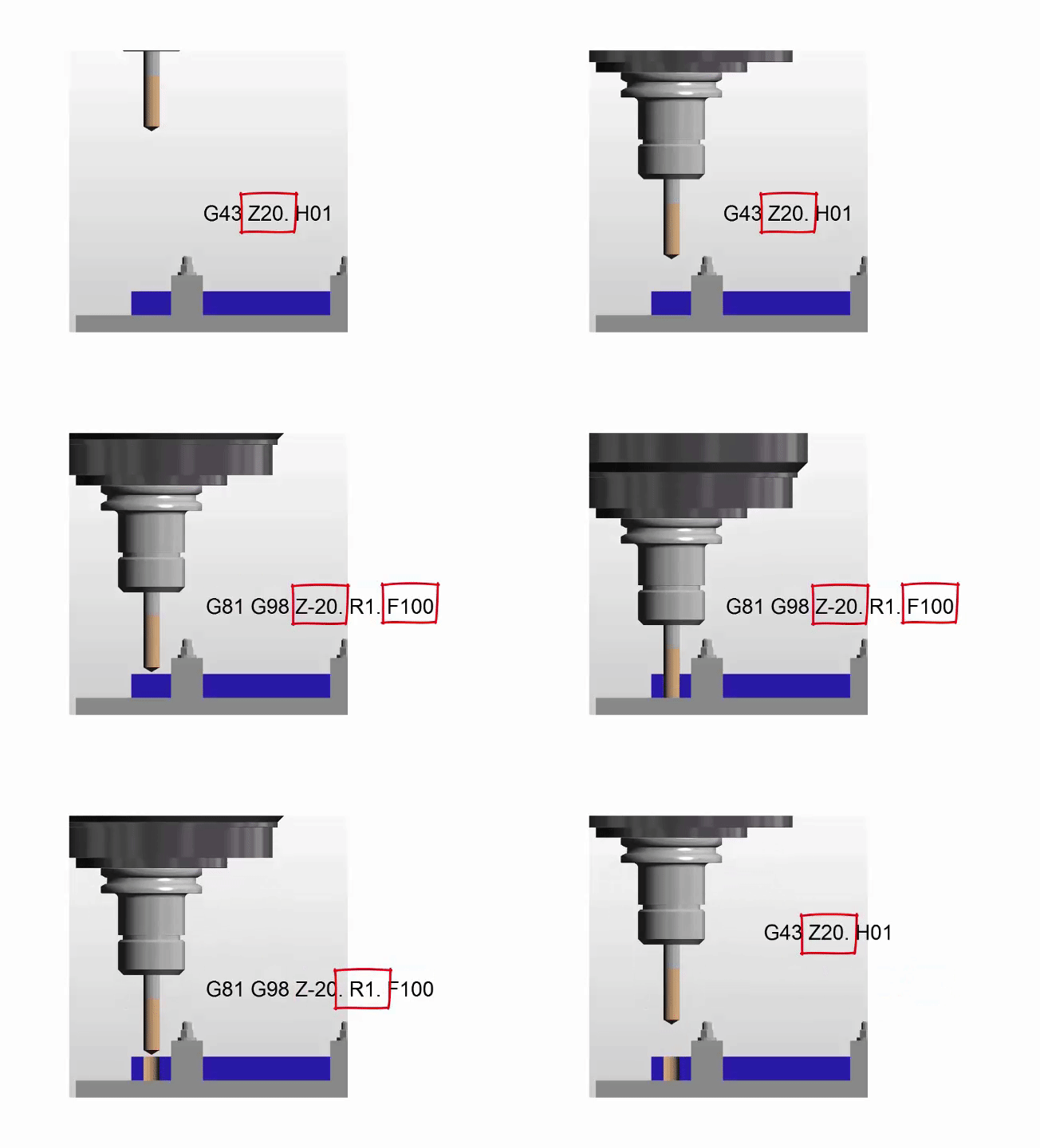
G98 and G99, a canned cycle is usually one line of code for example to drill a hole. This one line of code tells the machine all it needs to know about drilling my holes.
Depth
Feed-rate
A point in the Z axis to rapid to before drilling
Point to rapid back to after drilling
G81 Drilling Cycle Sample Program G98 and G99
What happens then is each time you give the machine a new position it will drill one of these holes.
This is great because you don’t have to worry about what’s going to happen.
Each hole will be identical unless you change one of the parameters in the cycle like the Z depth or the feed-rate.
Therefore if on one hole you put a different Z depth that hole and all subsequent holes will be to the new depth.
Easy As ABC
So all in all it’s a really easy way to drill holes. You tell it what you want and then each time you give a position you get a hole. Then when you get sick of drilling holes you type in G80 and it stops drilling holes.
Machine says “OK this turkey doesn’t want anymore holes” so from now on when the machine moves to a position nothing happens.
Mitsubishi Drill In Action
Mitsubishi Carbide
There are loads of Canned Cycles I can’t be bothered to tell you about them all cos I’m going out tonight otherwise I would explain them all. If you scrat around this website for a while you’ll find them all.
They all work in the same way but with some variations.
Now the video at the bottom of the page is about G98 and G99.
G98 and G99 are in all of the drilling and tapping cycles. You have one or the other. You can even miss it out if you can’t be arsed with it.
OK so assuming I want it, what does it do?
You may well ask.
I know for a fact that some of you, and I won’t mention names, put this on the line with the canned cycle but you ain’t got a clue what it does. Maybe you don’t even put it in because you’re frightened of what it might do..
Now’s the time to learn or you will have it on your conscience for the rest of your life.
By the way if you don’t give a flying shit what it does then I wouldn’t waste anymore time reading this.
Here is a lovely video on kittens for you to watch. Off you go.
G98 and G99 How it works.
If you prefer dogs read on.
First of all the tool will rapid to what we call an initial point which the control remembers ready in case you decide to program G98. (This is the last Z move you made before the cycle is called).
The tool will then rapid down close to the hole (this is called the R point). Don’t make this too far away or you will waste movement.
Tool feeds down in Z to the Z depth at the feed-rate you specified.
Then the tool will rapid back out of the hole. It can either rapid out to initial point (1) or the R point (2) depending on if you programmed G98 or G99.
How G81 works in action
Now if you program G99 it returns to the R point (2)
If you program G98 it returns to the initial point (1)
OK why on earth would I want that? Maybe you wish you had chosen to watch the kittens video, but read on.
Well……. if you made that initial point 50mm above the job (about 2 inches) and the rapid point was 1mm above the job (.040 inches).
You could drill all your holes in G99 and the drill would each time return to 1mm (.040 inches) above the part.
If you add a clamp to jump over just put G98 on the hole before and it will jump to 50mm (2 inches) above the part. Oh and it misses the clamp.
Change back to G99 and it stays down returning to 1mm (0.040 inches) above the part.
Admit it, you like it don’t you?
Please don’t try this at home by the way.
Get it? So you eliminate wasted moves. Good init.
G98 and G99 in Action
Oh and here is my video it explains how to use G98 and G99 to jump over clamps on a fixture.
The video is shit by the way but I had to learn (it’s been ages ago).
If you are completely crazy and you like this video, please don’t forget to subscribe to my YouTube channel by going to:CNC Training Centre
Let’s face it tapping on a CNC Machine can be a “right pain in the arse” as we say in the Midlands. But help is at hand. All you need is a bit of knowledge and the right equipment and it’s a dream, an absolute pleasure.
What is Rigid Tapping?
You mean you didn’t know? Well the first step is admitting you didn’t know.
Rigid tapping means the tap can remain rigid throughout the tapping cycle. It can be held in a chuck just like an endmill or a drill. The machine spindle locks in with the feedrate just like when you are screw cutting. You can buy tapping heads specially for this. They are no different to holding in a chuck but you get to use collets for holding the tap. These make it easy to change and it can’t spin.
Oh and you don’t need to remeasure the tap if you replace it.
So What Use Is This You Say
Well here are some of the advantages.
No need for expensive tension and compression tapping heads.
You can control the depth of the thread very accurately.
It is ok to re-tap the same hole if it needs to be deeper.
Peck Tapping of difficult materials is possible (Yes there is such a thing).
Quicker set-up times.
Feed is the same as the tap pitch.
But There’s a Catch
It’s an option. Sorry you might not have it.
Most modern machines do have Rigid Tapping as standard but the older the machine the less likely it is that you will have it.
Sorry but you need to look in those boring manuals.
In the above cycle the tap will rapid down first to Z3. as in the G43 line. On beginning the cycle it will then rapid to what is know as the R Point. In this case R1. (one mm above the hole).
If you want to know more about G98 and G99 then read the article above.
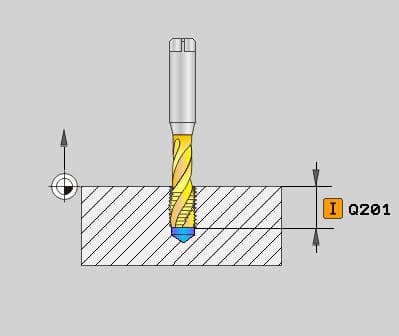
Heidenhain Uses Cycle 207
Oh! And did You Know This??
G94 feed per minute (feed is in mm per minute).
G95 feed per rev (feed this amount every revolution)
These two G codes are your friend when you’re tapping or should I say G95 feed per rev is your friend.
Why?
When Rigid Tapping G84 Canned Cycle on a Fanuc, Haas, Mazak or similar control it is best to use G95. This means that when you programme your G84 (Tapping Cycle) your feedrate is your pitch.
The really great thing here is that if you change the speed of the tap you don’t change the feed because it’s the pitch.
Bet you have made that mistake before???
You change the speed and forgot to change the feed. We all know what happened next.
How easy is that?
Oh and don’t forget to change back to G94 at the end of the tapping.
You will notice the Heidenhain does this automatically for you.
When you don’t have rigid tapping you need a tapping head like this.
Notice how it pulls out when the tap stops and reverses.
Ok So what’s Going on Here?
Let’s tap a hole.
Start spindle forward.
Feed to depth at correct speed.
Stop spindle (tap starts pulling out).
Reverse spindle (tap pulls out a bit more).
Start spindle (Needs to reach speed).
Feed out of hole.
So the problem is that when the spindle stops, reverses and starts up everything goes wrong.
But this tension and compression tapping head can take up all the slack.
Not An Exact Science.
Definitely not, depths will vary. You will probably need to do some hand tapping too.
Tapping Clutches
These are special collets designed to slip at a certain torque. This allows you to get to depth without breaking the tap.
You adjust the collar at the front to give the required torque.
You can’t use these on Rigid Tapping G84 Canned Cycle because the last thing you want is for the tap to stop rotating.
Haas Have The Answer
Rigid Tapping G84 Canned Cycle, check out this great video on how to stop the machine half way through tapping.
Recover it without busting the tap!!
Ok So Let’s Talk About Peck Tapping
Fanuc (if you have the option) is G84.2 just programme your normal tapping cycle but replace G84 with G84.2 and add a Q value which is your pecking depth.
G84.2 G98 Z-15. Q5. R1. F1.5
Why would one want to peck tap?
Holes that clog with swarf.
Difficult materials.
To impress visitors.
Don’t Have It? Don’t Despair You Don’t Need It if You have Rigid Tapping
If you programme this.
G84 G98 Z-5. R1. F1.5
Z-10.
Z-15.
Z-20.
G80
There you have it Peck Tapping.
So you move to a position and it taps a hole 5mm deep. Because you are in a canned cycle it will repeat the procedure at Z-10. Z-15. and Z-20.
To produce a full circle on a Fanuc or Haas G code type programming system is really easy.
Last week I was training four very experienced programmers and I asked them how they would programme a full circle.
The answers they gave shocked me, I had to take out my hip flask and drink a large shot of brandy.
What they were doing was perfectly correct but definitely not the simplest way.
One said he broke the circle into two halves. One said he copied some code he already had in the machine. The other one said he got the bloke who did it in two halves to do it for him. Oh and the other one used I and J and X and Y.
OK so just imagine you want to mill internally around a 40mm diameter circle.
G13 does everything. It’s the an all inclusive holiday of circular milling except you don’t gain weight and you’re not pissed everyday.
How cool is that and you even get a tangential approach. At my age you’re glad of all the tangential approaches you can get.
No there is no sexual innuendo here it just means you approach the circle using a circular move. You sort of creep up when it’s not looking.
Know what I mean??
Here is a nice picture to demonstrate.
Think about it, why would we do this?
Well the older and more inaccurate your CNC machine is the more likely it is that your machine will leave a mark at the entry and exit point. This is also dependant on the material and the size of the cut you are using.
A quick workaround for this is to just go round the circle twice (let’s go round again). It very often does the trick.
CNC Milling G02 G03
Oh by the way if I saw a tangential move that big I would think it was a wasted move. (It’s just to demonstrate). You only need a short tangential move to do the job.
The easiest way to programme a tangential approach is like the ones above. Coming in from North, South, East or West on the compass.
Now look at this.
This is the best way, although it’s more difficult to programme.
I think it’s South West on a Compass??
The reason is that there is no axis change of direction and no animals are injured or hurt in any way during the process.
If you watch the movement above and watch carefully what the X axis is doing. It changes direction before it is in contact with the circle. And the same thing on the way out of cut with the Y axis.
Direction Change When Using G02 G03 to mill full circle
When milling a full circle each time an axis changes direction there is a chance you will be left with a visible mark on the circle. These points are North South West and East on a compass.
Watch below to see where these points are. If you have a new machine there should be no visible mark on this change of direction.
On an old machine this can be really noticeable and cause real problem.
Circular Motion and Skid Marks
If you have an old machine you will know what I mean. Those little annoying marks where the machine changes direction. If CNC Machines were underpants then these would be the skid marks.
For my American readers in the UK we call those annoying brown marks at the back of your underwear skid marks. I don’t think you get them in America.
I have been working on a 12 year old Mazak Horizontal machine recently and was amazed at just how good a circle it produced. It beats the shit out of using a reamer. Oh and you can easily adjust the size with your D offset.
Just a note. If you do use circular milling to produce a bore just remember that if your cutter is not parallel then your bore won’t be either. So don’t use that crappy old re-ground cutter. Try n get the boss to buy you a shiny new one.
oh and just one other thing………..
Measure the bore at the top and the bottom.
Simple Full Circle Programme
G1 G41 X20. Y0 D1 F200. G3 I-20.
G1 G40 X0 Y0
There are actually four choices which produce four totally different circles.
And potentially a scrap part. So use those machine graphics to check your code if you got em!!
G3 I-20. (The one on the left and the one we used)